TorchSpec Disaggregates AI Training: What It Means For Your GPU Utilization
TorchSpec introduces fully disaggregated inference and training for speculative decoding, enabling your single H100s to train on 44K tokens and B200s on 200K tokens. Optimize your GPU memory.
Editorial Note
Reviewed and analysis by ScoRpii Tech Editorial Team.
In this article
Scalability Breakthroughs
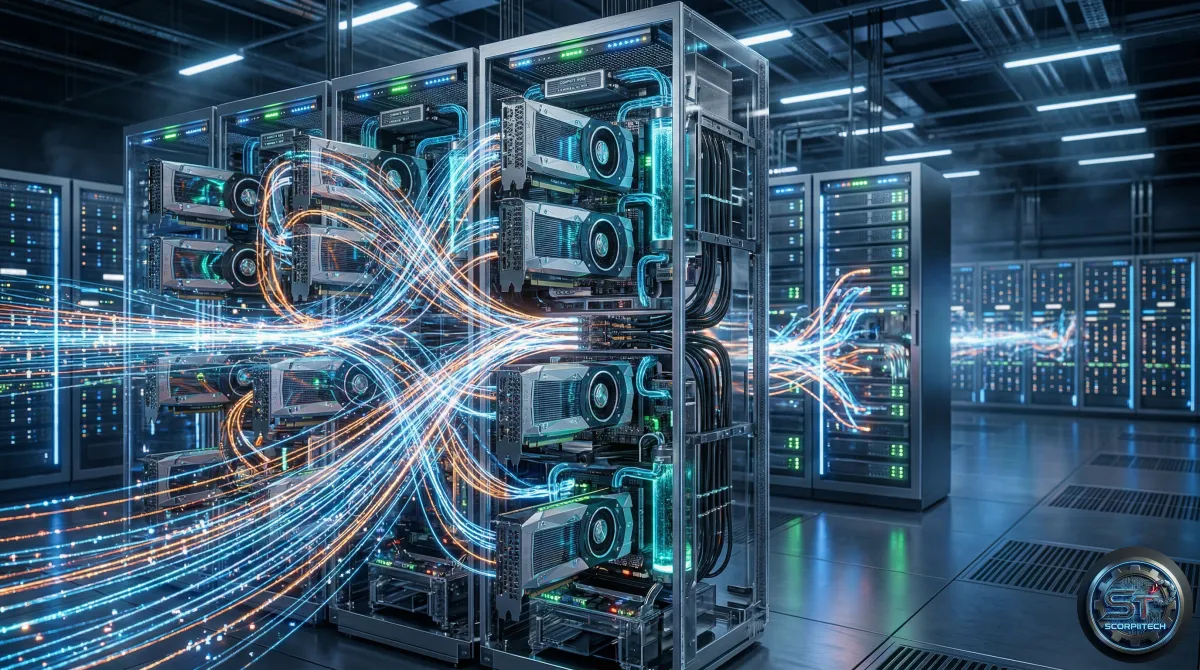
Your ability to efficiently train large language models (LLMs) often hits a roadblock due to memory constraints and network bottlenecks. The TorchSpec architecture addresses this by implementing a fully disaggregated design for inference and training, significantly impacting speculative decoding. By separating inference and training responsibilities across distinct GPU clusters, you can dedicate resources more efficiently.
This separation enables the inference cluster to allocate its full memory capacity to serving requests and generating hidden states, while the training cluster reserves its GPU memory entirely for the draft model. Communication between these clusters for streaming hidden states relies on either RDMA (Remote Direct Memory Access) or TCP. The TorchSpec Team, including Yubo Wang, Yinghui Liu, Shirley Wu, Junxiong Wang, Qingyang Wu, Bobbie Bie, Fan Yin, Chao Wang, Weicong Wu, and Jue Wang, developed this design to facilitate long-context training at 100,000 tokens with 600k data samples.
Deploy your next full-stack application effortlessly. Get $200 in free DigitalOcean credits to host your Docker containers, Laravel, or Python APIs.
Speculative Decoding Explained
Speculative decoding is an optimization technique designed to reduce inference latency in large language models. It involves using a smaller, faster 'draft' model to quickly generate a sequence of tokens. These speculative tokens are then passed to the larger, more accurate 'verifier' model. The verifier model checks the draft tokens in parallel, accepting correct tokens and generating correct ones from the point of error onward.
Sizing Your Single-Box VPS Architecture?
Calculate exact vCPU cores, RAM GB, NVMe storage, and estimated monthly budget for your traffic before migrating away from high-cost cluster providers.
This process significantly speeds up inference because the expensive verifier model doesn't need to generate every token sequentially. Instead, it only validates chunks produced by the faster draft model, leading to substantial throughput improvements. You can generate text much faster without sacrificing the quality of the larger model.
RDMA and Its Benefits
When you need high-throughput, low-latency communication between servers, especially for distributed computing tasks like AI model training, traditional TCP/IP can introduce CPU overhead and latency. Remote Direct Memory Access (RDMA) bypasses this by allowing one computer to directly access memory from another computer without involving the remote machine's CPU or operating system.
RDMA offloads data transfer operations from the CPU to specialized hardware, typically Network Interface Cards (NICs) that support RDMA protocols. This direct memory-to-memory transfer frees up CPU cycles for computation, dramatically reduces latency, and increases bandwidth, making it ideal for moving large datasets, such as hidden states between GPUs in a disaggregated system like TorchSpec.
Performance and Scale
The TorchSpec draft model demonstrates strong performance across various benchmarks, particularly with a lookahead of 3 tokens. Crucially, when employing a lookahead of 4 tokens and leveraging this disaggregated training model, a single H100 GPU can train on input sequences reaching up to 44,000 tokens. For even greater demands, a single B200 GPU can scale your training context to an impressive 200,000 tokens.
This level of context is critical for handling complex, long-form data common in many real-world applications. The inference cluster ensures full memory allocation for serving and hidden state generation, while the training cluster fully dedicates its GPU memory to the draft model. Key benefits include:
- Long-context training at 100,000 tokens with 600k data samples
- Scalability to 44,000 tokens with a single H100 GPU and a lookahead of 4 tokens
- Scalability to 200,000 tokens with a single B200 GPU
What This Means For You
The TorchSpec disaggregated architecture offers a significant change to how you might design and operate your LLM training infrastructure. You can achieve far longer context windows and more efficient utilization of your high-end GPUs by separating inference and training workloads. This implies a strategic re-evaluation of your cluster design, prioritizing high-speed interconnects like RDMA to maximize the benefits of data streaming.
If your current infrastructure struggles with memory limits during long-context training or if you're looking to optimize the lifespan and throughput of your expensive GPU resources, TorchSpec's approach merits your immediate attention. It suggests a future where your training and inference workloads are not bottlenecked by shared memory but empowered by dedicated, networked resources, directly impacting your total cost of ownership and model development velocity.
The Bottom Line for Developers
In conclusion, the TorchSpec architecture presents a novel solution to the challenges of large language model training. By adopting a disaggregated approach and leveraging RDMA for high-speed data transfer, you can significantly enhance the scalability and efficiency of your LLM workflows. As you consider the implications of this technology for your own projects, remember that the key to unlocking its full potential lies in a deep understanding of speculative decoding, RDMA, and the nuanced demands of large language model training.
Originally reported by
PyTorch BlogWhat did you think?
M. Numan
Founder & Lead ArchitectM. Numan leads architecture and software engineering at ScoRpii Tech, specializing in high-throughput backend services, autonomous multi-agent AI workflows, and cross-platform mobile apps. He writes production blueprints and architectural benchmarks for modern engineering teams.
Stay Updated
Get the latest tech news delivered to your reader.