Your DeepSeek-V3 Training Just Got 41% Faster on NVIDIA B200
PyTorch and Nebius achieved up to 41% faster DeepSeek-V3 MoE pre-training on 256-GPU NVIDIA B200 clusters. Understand the MXFP8 and DeepEP mechanisms for your operations.
Editorial Note
Reviewed and analysis by ScoRpii Tech Editorial Team.
In this article
Accelerating Deep Learning Training
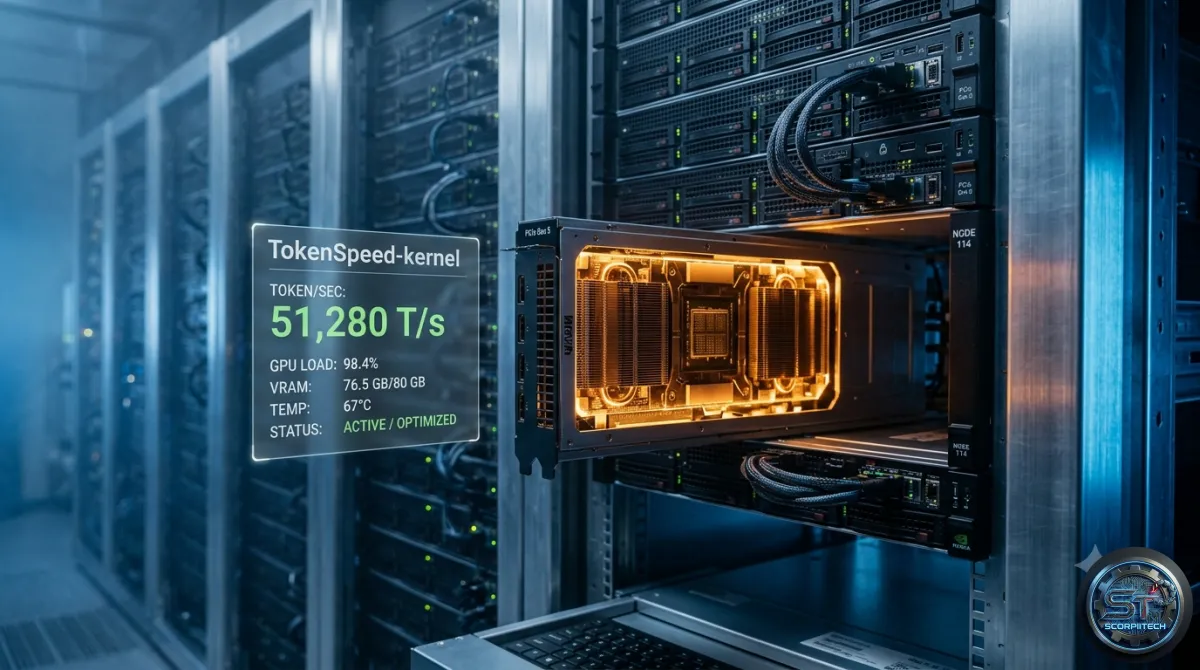
You can now achieve up to 41% faster pre-training for DeepSeek-V3 Mixture-of-Experts (MoE) models on a 256-GPU NVIDIA B200 cluster. This collaboration between PyTorch and Nebius focused on optimizing the training of 16B and 671B parameter variants. By integrating MXFP8 with DeepEP via TorchTitan and PyTorch-native tooling, you can reduce the compute cycles required for large MoE models.
Mixture-of-Experts (MoE) Architecture
If you're deploying large language models, you've likely encountered the MoE architecture. Unlike dense models, MoE models route inputs to a sparse subset of 'expert' sub-networks. A 'gating network' determines which experts process which parts of the input, allowing for a vast number of parameters without a proportional increase in computational cost per token. The key benefits of MoE models include:
Deploy your next full-stack application effortlessly. Get $200 in free DigitalOcean credits to host your Docker containers, Laravel, or Python APIs.
- Improved model capacity
- Increased sample efficiency
- Conditional computation for reduced computational cost
However, MoE models introduce complexities in load balancing and communication across distributed training environments.
Sizing Your Single-Box VPS Architecture?
Calculate exact vCPU cores, RAM GB, NVMe storage, and estimated monthly budget for your traffic before migrating away from high-cost cluster providers.
MXFP8 Precision and Quantization
When you encounter terms like MXFP8, you're looking at a strategy to reduce the numerical precision of computations. This reduction in bit-width significantly decreases memory footprint, allowing larger models or batches to fit on GPUs, and accelerates arithmetic operations on hardware like NVIDIA's Blackwell architecture. The challenge with MXFP8 lies in maintaining model accuracy, as too aggressive quantization can lead to numerical instability or convergence issues during training.
Operationalizing Peak Performance
The achievement of 41% faster pre-training for DeepSeek-V3 on the NVIDIA B200 cluster is a direct consequence of integrating MXFP8 with DeepEP via TorchTitan and PyTorch-native tooling. TorchTitan acts as a critical layer for orchestrating the efficient use of the underlying NVIDIA Blackwell architecture. By implementing MXFP8, the training process benefits from reduced memory bandwidth usage and increased arithmetic throughput on the B200's specialized 8-bit processing units.
What This Means For Your Deep Learning Operations
For you as a Staff Engineer or Systems Architect, these results have direct, tangible implications for your deep learning infrastructure and workflows. You can deploy larger, more capable models sooner, or experiment with more model variations within the same time budget. The proven efficacy of MXFP8 and DeepEP on NVIDIA B200 hardware, facilitated by PyTorch-native tooling and TorchTitan, provides a clear pathway for optimizing your own LLM pre-training pipelines.
The Bottom Line for Developers
In conclusion, the collaboration between PyTorch and Nebius has yielded significant performance improvements for DeepSeek-V3 MoE models. By leveraging MXFP8, DeepEP, and TorchTitan, you can unlock similar efficiency gains in your own MoE or large-scale model development efforts. As you continue to develop and optimize your deep learning infrastructure, consider the benefits of integrating these techniques to reduce compute cycles, lower operational costs, and accelerate your model development workflows.
Originally reported by
PyTorch BlogWhat did you think?
Stay Updated
Get the latest tech news delivered to your reader.