Your Llama4 Scout Training Just Got 30.2% Faster with MXFP8 and TorchAO
Achieve a +30.2% training speedup for Llama4 Scout with MXFP8 MoE training using TorchAO and TorchTitan on GB200, matching bfloat16 convergence.

Editorial Note
Reviewed and analysis by ScoRpii Tech Editorial Team.
In this article
Understanding Mixture of Experts (MoE) Architectures
You can significantly improve the efficiency of your AI models by leveraging Mixture of Experts (MoE) architectures. MoE models decouple the number of parameters from the computational cost per token, allowing for a dramatic increase in the total parameter count without commensurately increasing the computational burden. This approach enables large-scale models like Llama4 Scout to achieve unparalleled scale.
At the core of MoE architectures is a 'gate' or 'router' mechanism that directs each input token or sequence to a few specialized experts. This mechanism allows for efficient handling of complex tensor operations, making it ideal for large-scale AI models. You can achieve substantial economic and operational benefits by optimizing these architectures.
Need fast, secure, and affordable hosting for your next website or PHP application? We recommend Hostinger Managed Hosting. Get premium speeds, a free domain, and 24/7 expert support.
The Mechanism: Accelerating MoE with MXFP8 on GB200
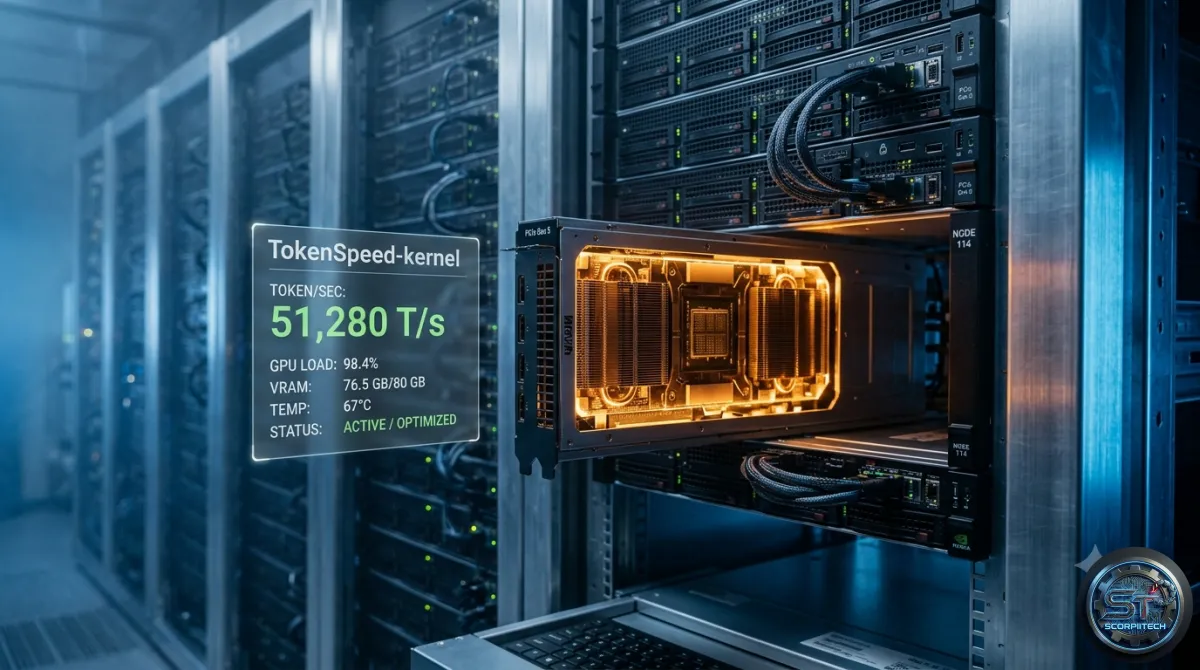
The application of MXFP8 MoE training primitives, specifically leveraging TorchAO and TorchTitan, can significantly accelerate your AI model training. Demonstrations have shown a 1.3x training speedup compared to standard BF16 implementations for Llama4 Scout on a GB200 cluster. This translates to a +30.2% improvement in training speed while ensuring convergence remains equivalent to bfloat16 precision.
Technical analysis reveals that this acceleration originates from microbenchmarks comparing the combined duration of the forward and backward pass of the autograd function powering MXFP8 MoE training against the bf16 baseline. By optimizing these critical compute kernels, particularly on NVIDIA's advanced GB200 hardware, TorchAO and TorchTitan enable a significant reduction in computation time per iteration. You can achieve a substantial reduction in training time, resulting in substantial economic and operational benefits.
Key Features and Benefits
Some key features and benefits of MXFP8 MoE training primitives include:
- 1.3x training speedup compared to standard BF16 implementations
- +30.2% improvement in training speed
- Equivalent convergence to bfloat16 precision
- Significant reduction in computation time per iteration
- Substantial economic and operational benefits
Practical Implications for Your Infrastructure
The integration of MXFP8 with PyTorch's TorchAO and TorchTitan signifies a maturing ecosystem for deploying and optimizing large-scale AI models. For you, this means that your GB200 clusters can now yield significantly more output per unit of time and energy. You can complete more training runs within the same budget or reduce your overall spend for a given training objective.
What This Means For You
The immediate takeaway is that you have a proven method to significantly enhance the efficiency of your Llama4 Scout training. A 30.2% speedup, coupled with bfloat16-equivalent convergence, means you can achieve more within your existing compute budget or simply complete projects faster. This efficiency gain directly impacts your operational costs and time-to-market for complex AI models.
The Bottom Line for Developers
In conclusion, optimizing your AI models with MXFP8 MoE training primitives can have a significant impact on your infrastructure and operations. By leveraging these primitives, you can achieve substantial economic and operational benefits, reduce training time, and improve the efficiency of your AI models. You can refer to the TorchAO MoE training documentation for detailed commands and configurations to replicate these benchmarks and integrate these primitives into your own Llama4 Scout training workflows.
Originally reported by
PyTorch BlogWhat did you think?
Stay Updated
Get the latest tech news delivered to your reader.