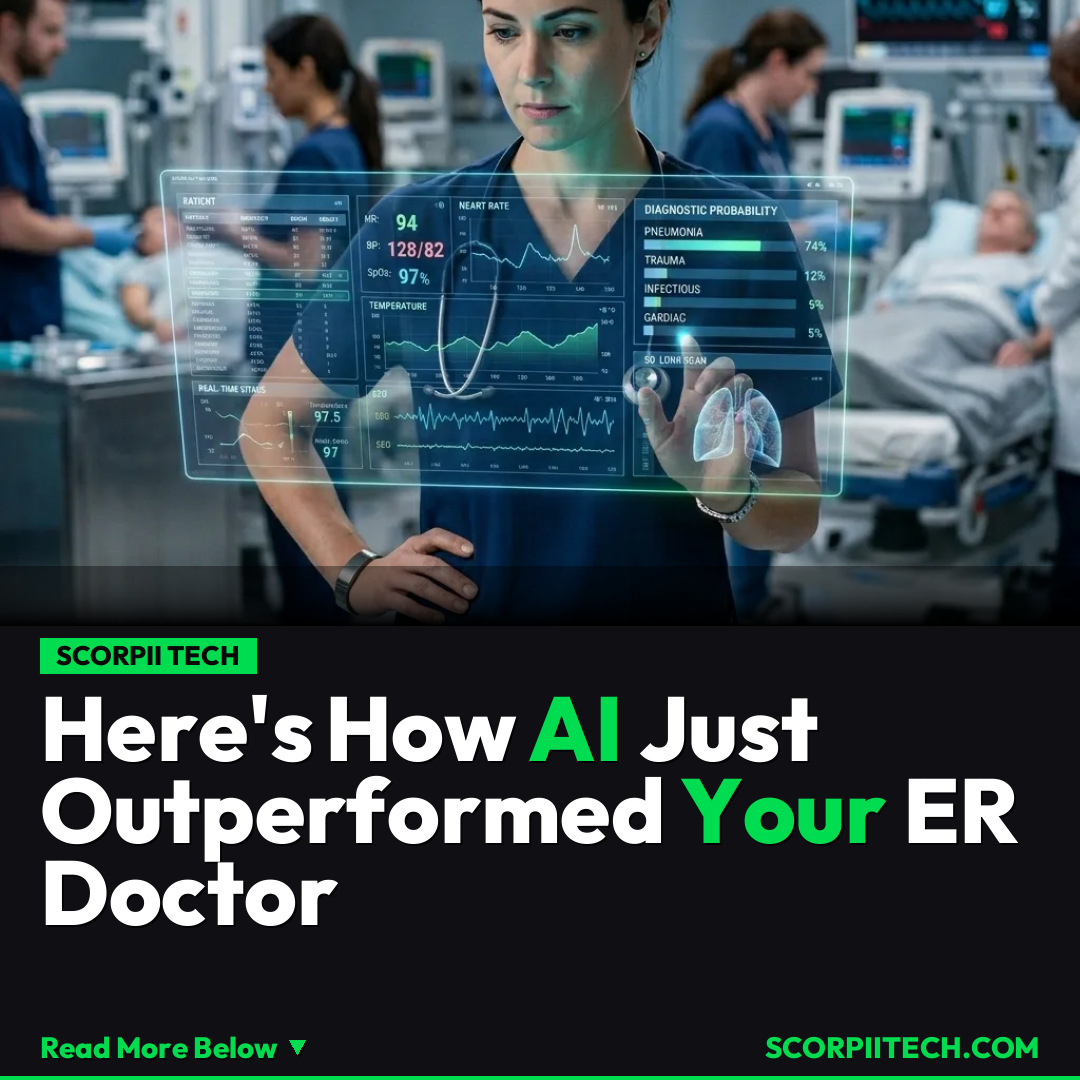
Here's How AI Just Outperformed Your ER Doctor
A new Harvard study reveals OpenAI's AI models were more accurate than human ER doctors in diagnosing complex cases. Discover what this means for your future healthcare.
Editorial Note
Reviewed and analysis by ScoRpii Tech Editorial Team.
In this article
Imagine walking into the emergency room, needing a critical diagnosis, and finding out an AI might be more accurate than the doctor. Sound like science fiction? Well, according to a groundbreaking study recently published in Science, it's becoming a startling reality. You might soon be relying on artificial intelligence for medical insights more than you ever thought possible.
Key Details
This pivotal research, spearheaded by lead authors Arjun Manrai, who heads an AI lab at Harvard Medical School, and Adam Rodman, a doctor from Beth Israel Deaconess Medical Center, delved deep into how large language models perform in various medical scenarios. Their focus included real emergency room cases, providing a crucial, real-world context for AI's diagnostic abilities. The findings are clear: at least one of the models tested demonstrated a higher accuracy rate than human physicians.
Deploy your next full-stack application effortlessly. Get $200 in free DigitalOcean credits to host your Laravel or Python APIs.
The study, conducted at Beth Israel Deaconess Medical Center, rigorously put OpenAI's cutting-edge o1 and 4o models to the test. Researchers compared their diagnostic performance against that of human doctors, leveraging extensive electronic medical records. As Manrai eloquently put it, "We tested the AI model against virtually every benchmark, and it eclipsed both prior models and our physician baselines." This isn't just a marginal improvement; it's a significant leap in AI's capability for medical diagnosis.
The implications of AI models offering more accurate diagnoses than human emergency room doctors are profound. This research directly challenges traditional medical practices and opens the door to a future where AI plays a more central role in patient care. The study, reported by The Guardian, paints a vivid picture of the immediate potential AI holds for transforming healthcare.
Why This Matters
For you, this means the future of your medical care could involve AI as a powerful, diagnostic co-pilot, or even the primary diagnostician in complex cases. The potential for AI to dramatically improve medical diagnosis is immense, promising faster, more accurate identifications of conditions and potentially better patient outcomes. Think about reduced misdiagnoses, quicker treatment paths, and a healthcare system that leverages every available tool for your well-being.
However, with great power comes great responsibility, and this study also shines a spotlight on a critical issue: the absence of a formal framework for accountability around AI diagnoses. If an AI makes a diagnostic error, who is responsible? The developer? The deploying hospital? The supervising doctor? This lack of clarity introduces a significant controversy and highlights a crucial regulatory gap that needs urgent attention before widespread adoption.
The Bottom Line
You're witnessing a seismic shift in medicine, where AI is proving its capability to outperform human experts in specific, high-stakes scenarios. While the prospect of more accurate diagnoses is incredibly exciting and promises to enhance your future healthcare experiences, it also demands your attention on the ethical and regulatory front. As these advancements accelerate, it's vital for you to stay informed and even advocate for the creation of robust accountability frameworks. Understanding this balance between innovation and responsibility will be key to embracing an AI-augmented medical future with confidence.
Originally reported by
TechCrunchWhat did you think?


Stay Updated
Get the latest tech news delivered to your reader.