AI Doctors Are Here: What This Means For Your Health
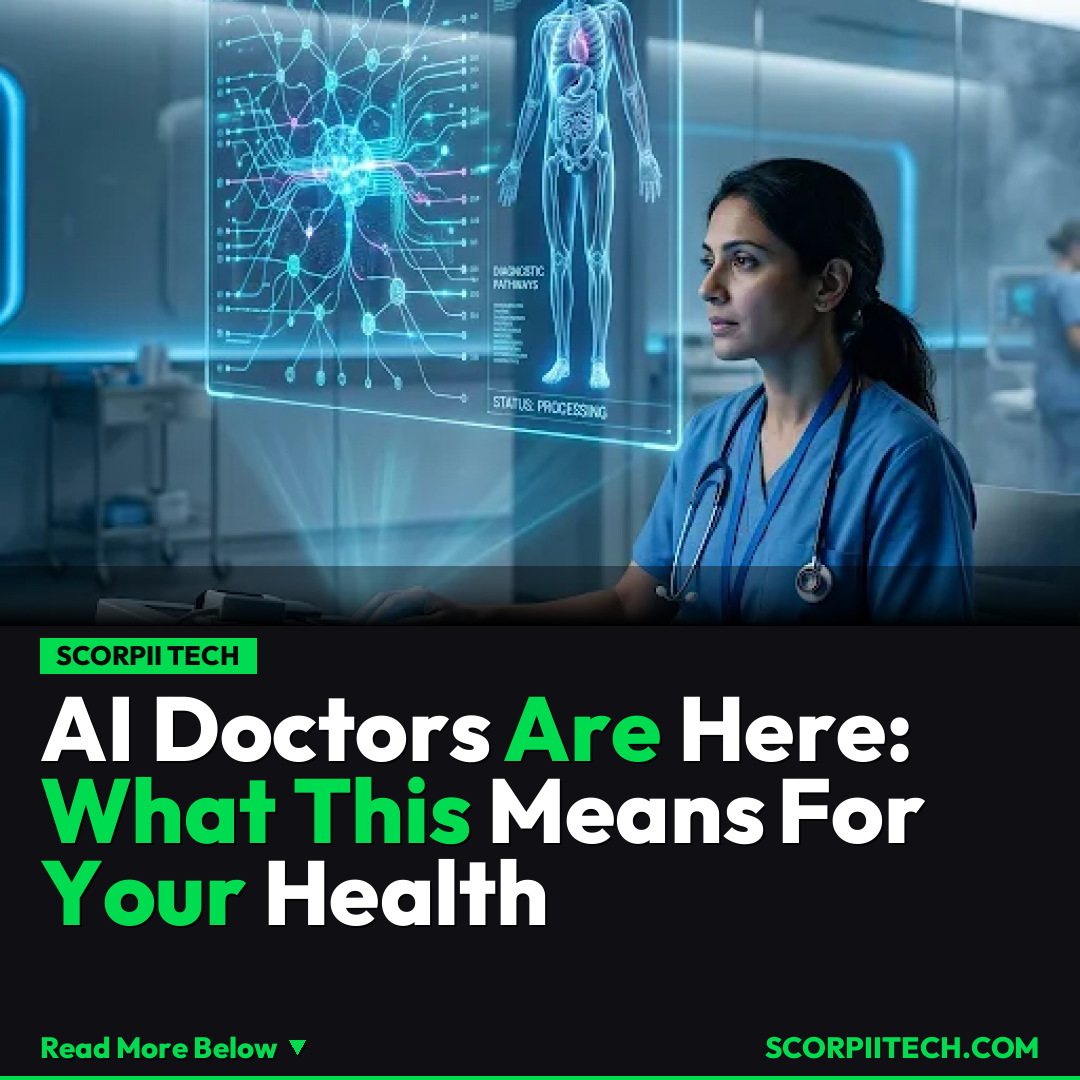
Cutting-edge AI can now diagnose medical conditions as well as or better than doctors. Discover what this breakthrough means for your health and the future of medicine.
Editorial Note
Reviewed and analysis by ScoRpii Tech Editorial Team.
In this article
Imagine a future where your medical diagnosis isn't solely in the hands of a human, but also an artificial intelligence capable of "reasoning." Well, that future just arrived. A study published Thursday in Science reveals that AI can now diagnose real-life medical scenarios as well as, or even better than, physicians. This isn't science fiction anymore; it’s a significant leap in how you might experience healthcare.
Key Details
This groundbreaking research, highlighted in Science, showcases the remarkable capabilities of advanced AI models like OpenAI’s GPT-4 and the specialized o1 model. These systems demonstrate a profound ability to "reason" through complex medical information, allowing them to assess and diagnose conditions with an accuracy often paralleling, and sometimes surpassing, that of experienced human doctors.
Deploy your next full-stack application effortlessly. Get $200 in free DigitalOcean credits to host your Laravel or Python APIs.
Key insights for the study involved leading institutions, including the University of California, San Francisco (where Dr. Robert Wachter is a professor and chair of the Department of Medicine), and Mt. Sinai (home to Dr. Ashwin Ramaswamy, an instructor of urology). Other contributing organizations included Beth Israel Deaconess Medical Center and the Flinders Health and Medical Research Institute, indicating broad engagement in this field.
Crucially, while the results are impressive, a nuance exists: "The question is how closely this replicates real life, and the answer is moderately well but not perfectly." This means that while AI's diagnostic abilities excel in controlled settings, real-world application still requires ongoing development to handle the full, unpredictable complexities of human health.
Why This Matters
This development is a game-changer for your healthcare experience. If AI can reason and diagnose effectively, it promises faster, more accurate diagnoses, particularly in areas with limited specialist access. Your doctor could soon be augmented by an AI assistant that rapidly sifts through vast medical literature and patient data, providing insights that might otherwise take hours. This empowers medical professionals with a powerful tool, rather than replacing them.
For you, this could translate into fewer misdiagnoses and more targeted treatments. While "moderately well but not perfectly" means human oversight remains critical, AI's potential as a diagnostic co-pilot is immense. It signals a future where technology works hand-in-hand with medical expertise to significantly improve patient outcomes. This transformation, often described as "A Giant Leap" for healthcare, is actively shaping the future of medical diagnosis.
The Bottom Line
As of April 30, 2026, you are witnessing a pivotal moment in medicine. AI's ability to reason and diagnose like a physician is no longer a futuristic concept but a published reality. While the technology is still maturing—especially in its real-world replication—its implications for your health are profound. Stay informed about these advancements, because the next time you visit your doctor, an AI might just be helping to ensure you get the best possible diagnosis. This breakthrough underscores a future where intelligent systems play an increasingly vital role in maintaining your well-being, demanding a careful balance of innovation and human expertise.
Originally reported by
MashableWhat did you think?


Stay Updated
Get the latest tech news delivered to your reader.