Running PyTorch Models on Apple Silicon GPUs with the ExecuTorch MLX Delegate
Unlocking Faster Generative AI WorkloadsIf you are deploying PyTorch models on Apple Silicon, your generative AI workloads on macOS can now achieve 3-...
Editorial Note
Reviewed and analysis by ScoRpii Tech Editorial Team.
In this article
Unlocking Faster Generative AI Workloads
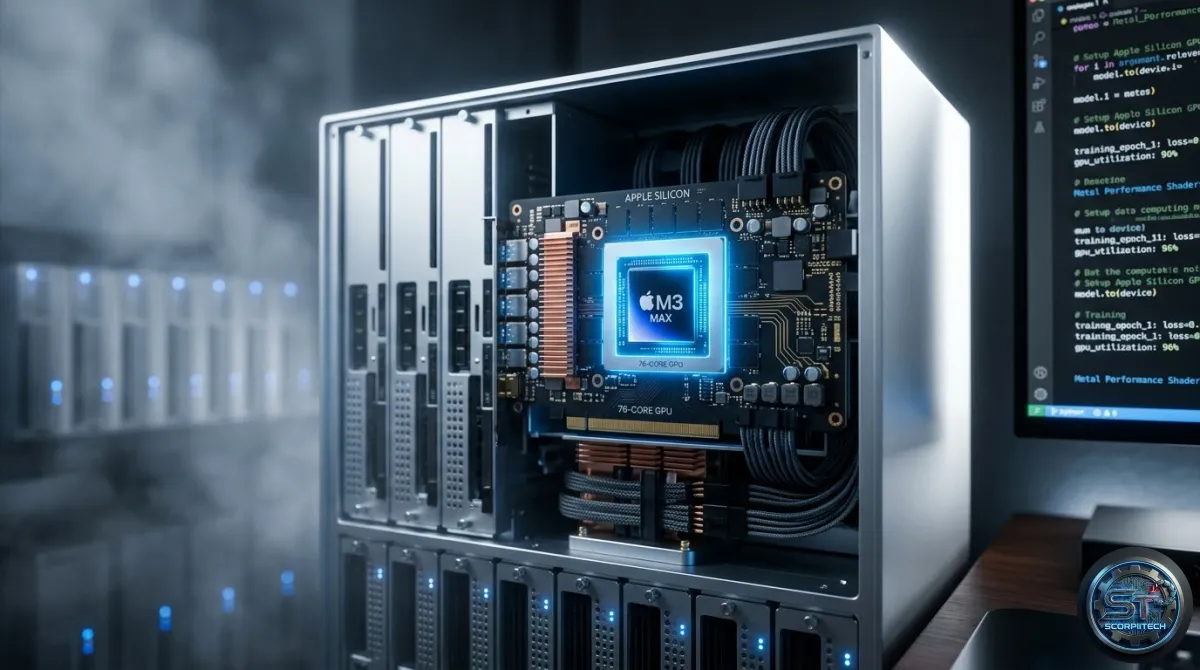
If you are deploying PyTorch models on Apple Silicon, your generative AI workloads on macOS can now achieve 3-6x higher throughput. This significant performance uplift stems from the new ExecuTorch MLX Delegate, a critical integration enabling more efficient local processing on Apple's dedicated hardware.
The ExecuTorch framework, an LF project, is designed to facilitate the deployment of PyTorch models to edge devices, ranging from mobile to embedded systems. Its core architecture relies on a system of delegates to offload operations to device-specific, optimized hardware backends.
Deploy your next full-stack application effortlessly. Get $200 in free DigitalOcean credits to host your Docker containers, Laravel, or Python APIs.
Technical Details of the ExecuTorch MLX Delegate
The ExecuTorch MLX Delegate introduces a direct pathway for PyTorch operations to leverage Apple's MLX array framework on Apple Silicon GPUs. This delegate specifically supports approximately 90 ATen operations, which are the fundamental tensor operations within PyTorch's backend.
Sizing Your Single-Box VPS Architecture?
Calculate exact vCPU cores, RAM GB, NVMe storage, and estimated monthly budget for your traffic before migrating away from high-cost cluster providers.
To break down the key features of the ExecuTorch MLX Delegate, consider the following points:
- Direct integration with Apple's MLX framework for optimized GPU acceleration
- Support for approximately 90 ATen operations, enabling efficient tensor computations
- Seamless integration with the ExecuTorch framework for easy deployment
Performance Implications for Generative AI Workloads
The practical impact of the ExecuTorch MLX Delegate is a substantial performance increase for generative AI workloads. You can now expect a 3-6x higher throughput when running these models locally on macOS. This improvement is directly attributed to the delegate's ability to efficiently utilize the Apple Silicon GPU.
This acceleration translates to faster inference times for tasks like text generation, code completion, or local image synthesis. For developers, this means quicker iteration cycles during local model development and testing.
What This Means For Your Deployment Strategy
If you are currently deploying or planning to deploy PyTorch models on macOS using Apple Silicon, integrating the ExecuTorch MLX Delegate into your build pipeline is a clear path to enhanced performance. Your existing ExecuTorch models, particularly those involved in generative AI, stand to benefit immediately from these throughput improvements.
The Bottom Line for Developers
The introduction of the ExecuTorch MLX Delegate marks a significant step forward for developers working with PyTorch models on Apple Silicon. By leveraging this new delegate, you can unlock faster generative AI workloads, streamline your development process, and create more efficient, high-performance applications.
Originally reported by
PyTorch BlogM. Numan Lead Developer & CEO
Founder & Lead Architect at ScoRpii Tech · Full-Stack & AI Systems Specialist
M. Numan leads architecture and software engineering at ScoRpii Tech, specializing in high-throughput backend services, autonomous multi-agent AI workflows, and cross-platform mobile apps. He writes production blueprints and architectural benchmarks for modern engineering teams.
What did you think?

Stay Updated
Get the latest tech news delivered to your reader.