How We Built Paisa Track: Scaling a Production Expense Manager with Flutter and FastAPI
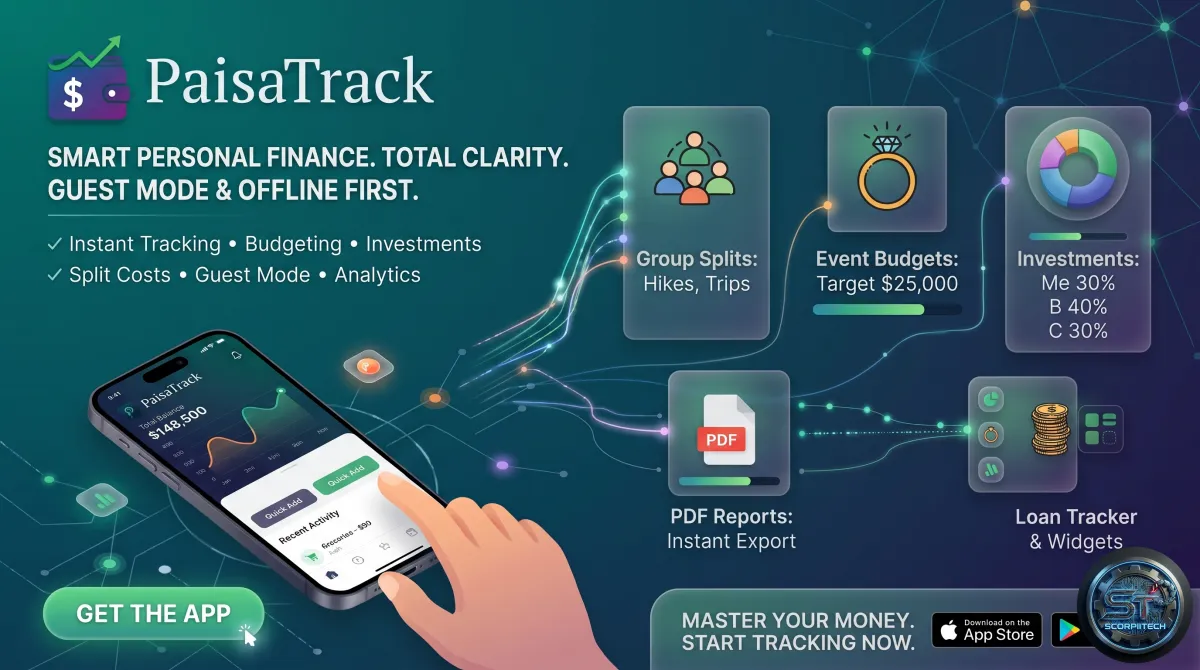
When building Paisa Track—a comprehensive personal finance and expense management app—we faced a common architectural dilemma: How do we build an app...
In this article
When building Paisa Track—a comprehensive personal finance and expense management app—we faced a common architectural dilemma: How do we build an app that feels incredibly fast and works offline, but also syncs securely with a robust backend for group expense sharing?
The solution? A hybrid architecture leveraging Flutter (Riverpod + Drift) on the frontend and Python (FastAPI + PostgreSQL) on the backend.
Deploy your next full-stack application effortlessly. Get $200 in free DigitalOcean credits to host your Docker containers, Laravel, or Python APIs.
In this case study, our engineering team at ScoRpii Tech breaks down the architectural decisions that allow Paisa Track to handle thousands of transactions seamlessly.
Sizing Your Single-Box VPS Architecture?
Calculate exact vCPU cores, RAM GB, NVMe storage, and estimated monthly budget for your traffic before migrating away from high-cost cluster providers.
Try the Live App:
You can download the production version of Paisa Track directly from the Google Play Store to experience the offline-first SQLite sync and Riverpod state management in action. (Note: The iOS version is currently in private beta).
The Challenge: Offline-First Reliability
Personal finance apps demand immediate responsiveness. If a user is at a grocery store with poor cell reception, they shouldn't have to wait for a loading spinner to log a $12 receipt. The app must be offline-first.
However, Paisa Track isn't just a solo expense tracker. It includes complex features like:
- Group Expense Splitting: Real-time updates when a friend pays you back.
- Loan Management: Syncing shared loan balances between users.
- AI Receipt Scanning: Processing images using Google ML Kit.
We needed a local database powerful enough to handle relational queries (like calculating group balances) and a backend capable of fast, concurrent API requests.
The Frontend: Flutter, Riverpod, and Drift
1. State Management with Riverpod
We chose Riverpod over standard Provider or GetX because it offers compile-time safety and easily handles asynchronous data streams. In a finance app where balances must update instantly across multiple screens, Riverpod's reactive architecture ensures the UI is always a true reflection of the local state.
2. Local Database with Drift (SQLite)
To achieve true offline capability, we utilized Drift (formerly Moor), a reactive persistence library for SQLite in Flutter. Unlike simple key-value stores (like Hive, which we only use for lightweight settings), Drift allows us to write complex SQL queries natively in Dart.
When a user adds an expense:
- It is immediately written to the local SQLite database via Drift.
- The UI updates instantly via Riverpod streams.
- A background sync worker queues the transaction to be sent to the server when an internet connection is available.
The Backend: Python FastAPI and PostgreSQL
While we often use Laravel for heavy web-based SaaS platforms, we opted for FastAPI (Python) for Paisa Track's backend. Why?
1. Extreme Concurrency
FastAPI is built on Starlette and Pydantic, making it one of the fastest Python frameworks available. Because Paisa Track's mobile app acts as a highly chatty client (frequently syncing local queues with the server), FastAPI's asynchronous request handling effortlessly manages the load.
2. Python Ecosystem for AI and OCR
A core feature of Paisa Track is AI receipt scanning. While we use Google ML Kit on the device for immediate text extraction, having a Python backend allowed us to seamlessly integrate PyTesseract and robust data-parsing pipelines server-side for fallback processing and deeper receipt analysis.
3. SQLAlchemy and Alembic
We used SQLAlchemy as our ORM to interact with PostgreSQL. The complex logic of group expense splitting (e.g., calculating who owes whom in a 5-person trip with uneven splits) is handled efficiently through optimized relational queries. Alembic manages our database migrations, ensuring our schema evolves safely.
The Result
By separating concerns—giving the Flutter app a heavy, offline-capable SQLite database, and providing a lightning-fast Python API for synchronization—we achieved a production-ready system that boasts:
- Zero-Latency UI: Adding expenses feels instantaneous.
- Seamless Syncing: Users can switch between devices without losing data.
- Scalability: The FastAPI backend handles high concurrency with minimal server resources.
Looking to Build a Complex Mobile Application?
At ScoRpii Tech, we specialize in architecting production-ready applications across Flutter, Python, and Laravel. Whether you need an offline-first mobile app or a heavily integrated AI backend, our team has the proven experience to deliver.
Calculate Your App Cost Today or Contact Us for a Consultation.
What did you think?
M. Numan
Founder & Lead ArchitectM. Numan leads architecture and software engineering at ScoRpii Tech, specializing in high-throughput backend services, autonomous multi-agent AI workflows, and cross-platform mobile apps. He writes production blueprints and architectural benchmarks for modern engineering teams.
Related Articles

Production Engineering Deep Dive: storytold/lightcraft — A Bare-Metal Blueprint for Open-Source Lightroom in 2026
5 days ago
Architecture Deep Dive: okf-memory/okf-agent-memory — Git-Native Persistent Memory for AI Coding Agents. Implement in 2026
1 week ago
De-Robotizing AI Prose: Why LLMs Write Predictably & How Linguistic Burstiness Bypasses Synthetic Patterns in 2026
1 week agoStay Updated
Get the latest tech news delivered to your reader.