Architecture Deep Dive: okf-memory/okf-agent-memory — Git-Native Persistent Memory for AI Coding Agents. Implement in 2026
Deploy okf-agent-memory on bare-metal VPS with Docker Swarm in 2026. Git-native memory with sub-300µs BM25 search for AI coding agents under $60/month.
Editorial Note
Reviewed and analysis by M.Numan
In this article
- The Engineering Reality: The Cloud Tax on AI Memory Systems
- Deep Architecture Teardown: Git-Native Storage & In-Memory BM25 Search
- Model Context Protocol (MCP) Setup: Integrating with Claude Code & Cursor
- Self-Hosted Production Blueprint: Docker Swarm & Traefik
- Real Production Configuration: Docker Swarm Compose Specification
- Production Python Client: Autonomous Context Retrieval
- Benchmark Comparison Matrix: AI Agent Memory Solutions (2026)
- Production Trade-Offs, Failure Modes & Edge Cases
- Strategic Decision Checklist & Advisory CTA
Executive Summary: Engineering Persistent Memory for AI Coding Agents
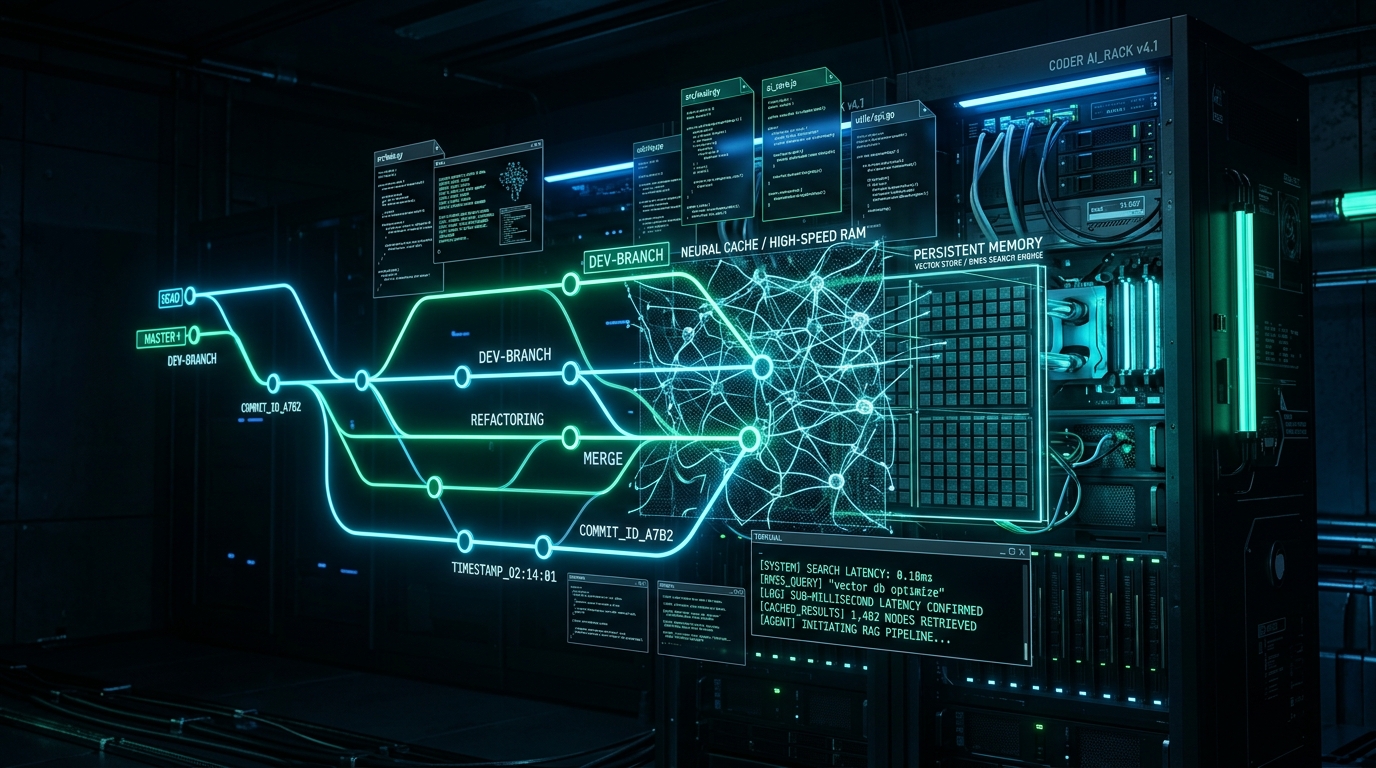
Autonomous coding agents require low-latency, version-controlled context to avoid repetitive instructions and hallucinated architectural decisions. While conventional teams reflexively spin up managed vector databases (Pinecone, Qdrant) inside multi-node Kubernetes clusters—incurring a $300–$500/month "Kubernetes Tax" and 200ms+ network hops—the okf-agent-memory paradigm introduces ruthless architectural efficiency. Operating on Google's Open Knowledge Format (OKF v0.2), it stores structured markdown memory directly in Git, compiles an in-memory BM25 search index in local RAM, and serves sub-300µs lexical retrievals through an embedded Model Context Protocol (MCP) server. Deployed on a single NVMe VPS ($45–$60/mo) via Docker Swarm, it sustains thousands of agent queries per second with complete cryptographic auditability.
The Engineering Reality: The Cloud Tax on AI Memory Systems
During the initial wave of generative AI, "agent memory" was simply a euphemism for context window stuffing: concatenating thousands of conversation tokens into the system prompt and hoping the attention heads wouldn't suffer from middle-loss degradation. In 2026, production AI engineering requires structured, persistent, and verifiable memory. However, mainstream solutions have inherited the worst habits of cloud hyperscaler over-engineering:
Deploy your next full-stack application effortlessly. Get $200 in free DigitalOcean credits to host your Docker containers, Laravel, or Python APIs.
- External Vector Database Overhead: Spinning up Pinecone, Weaviate, or managed Milvus clusters requires dedicated embedding API calls for every document change, a complex ingestion pipeline, and recurring token charges (often 6,000+ tokens per retrieval call in frameworks like LoCoMo).
- Compounding Retrieval Latency: Passing context through external embedding inference endpoints, vector similarity search clusters, and network caching layers introduces 150ms to 400ms of perceptible latency per turn. For an interactive coding assistant executing continuous tool-call loops, this lag breaks developer flow.
- The Baseline Kubernetes Tax: Deploying vector databases and caching layers on AWS EKS or GCP GKE incurs a mandatory overhead toll before running application code:
- AWS EKS Control Plane: $73.00/month per cluster.
- Redundant NAT Gateways: $64.00–$96.00/month across availability zones.
- Application Load Balancer: $25.00/month plus data processing fees.
- CloudWatch Logging & Cross-AZ Egress: $60.00–$150.00/month.
- Data Siloing & Versioning Blindspots: Vector embeddings are opaque mathematical vectors. When code refactors deprecate a function or alter an API contract, traditional vector stores cannot leverage standard
git difforgit logprimitives to prune stale knowledge cleanly.
Sizing Your Lean AI Agent Infrastructure?
Calculate exact vCPU cores, RAM GB, NVMe storage, and estimated monthly budget for your traffic before migrating away from high-cost cluster providers.
Deep Architecture Teardown: Git-Native Storage & In-Memory BM25 Search
okf-agent-memory rejects the distributed database trap by establishing the developer's Git repository as the authoritative single source of truth for agent memory. Built in Go as a high-performance static binary, the system couples four core primitives:
- Open Knowledge Format (OKF v0.2): Knowledge units, architectural decision records (ADRs), conventions, and code pattern libraries are stored as clean Markdown documents with strict YAML frontmatter (tags, category, confidence tier, and verification status) in a dedicated
knowledge/directory. - Zero-Network In-Memory BM25 Search: Upon startup or background
git pull, the service loads the entire OKF corpus into RAM and constructs an optimized BM25 (Best Match 25) index across titles, tags, and document bodies. Search queries execute against local memory in sub-300 microseconds—over 500x faster than network-bound vector searches. - Lexical Determinism for Code: While vector embeddings excel at broad conversational topics, they frequently hallucinate or rank poorly for exact technical symbols like
handleWebhookEvent,Caddyfiledirectives, or SQL migration constraints. BM25 delivers precise keyword matches without token embedding distortion. - Progressive Disclosure Protocol: Rather than dumping full 4,000-word guides into the prompt, the agent queries for brief summaries (300 tokens) and only requests deep implementation blocks when required, drastically cutting per-turn token consumption.
Model Context Protocol (MCP) Setup: Integrating with Claude Code & Cursor
One of the strongest architectural advantages of okf-agent-memory in 2026 is its native support for the Model Context Protocol (MCP). AI coding assistants (such as Claude Code, Cursor, or custom autonomous agent sidecars) connect directly to the memory server via standard JSON-RPC tools:
{
  "mcpServers": {
    "agent-memory": {
      "command": "okf-agent-memory",
      "args": ["serve", "--mcp", "--repo", "/path/to/project/.agents/knowledge"],
      "env": {
        "OKF_LOG_LEVEL": "info",
        "OKF_INDEX_REFRESH_INTERVAL": "30s"
      }
    }
  }
}
Once registered, the AI assistant autonomously invokes memory discovery tools during its planning phase:
okf_search(query="auth token rotation", limit=3): Scans the in-memory BM25 index and returns relevant titles, tags, and summary snippets in <1ms.okf_show(path="security/token_rotation.okf", section="implementation"): Reads the specific architectural guide without blowing up the context window.okf_create(path="bugs/safari_layout_fix.okf", content="..."): Commits a new learned lesson directly into Git for future agent sessions.
Self-Hosted Production Blueprint: Docker Swarm & Traefik
Deploying okf-agent-memory on self-hosted infrastructure gives technical organizations complete ownership of their knowledge assets while eliminating recurring database subscriptions:
- Lean Hardware Footprint: A standard 4-core, 8GB RAM NVMe VPS (such as a Hetzner Cloud CX22 or DigitalOcean Droplet at $15–$35/month) can index over 50,000 OKF documents while consuming less than 2GB of resident memory.
- Persistent Git Mirroring: The service mounts a persistent volume for the local Git repository, polling remote webhooks or using SSH deploy keys to pull knowledge updates automatically.
- Zero-Downtime Rolling Updates: Docker Swarm orchestrates updates with
order: start-first, ensuring the new in-memory index compiles before the old container terminates. - Automated TLS via Traefik or Caddy: Edge reverse proxies handle Let's Encrypt certificates and internal routing with zero manual maintenance.
Real Production Configuration: Docker Swarm Compose Specification
Below is the production-ready docker-compose.yml specification for deploying okf-agent-memory under Docker Swarm with Traefik routing, health check validation, and memory safety caps:
# Production Docker Compose for okf-agent-memory Architecture
# Designed for Docker Swarm or Single-Host NVMe VPS
version: '3.8'

services:
  okf-agent-memory:
    image: scorpiitech/okf-agent-memory:1.2.0
    command: >
      sh -c "
        if [ ! -d /app/knowledge ]; then
          mkdir -p /app/knowledge && chmod 700 /app/knowledge
        fi &&
        eval $(ssh-agent -s) &&
        echo \"$$GIT_SSH_KEY_BASE64\" | base64 -d > /root/.ssh/id_rsa &&
        chmod 600 /root/.ssh/id_rsa &&
        ssh-add /root/.ssh/id_rsa &&
        ssh-keyscan github.com >> /root/.ssh/known_hosts &&
        git clone $$GIT_REPOSITORY_URL /app/knowledge -b $$GIT_BRANCH || true &&
        cd /app/knowledge && git pull origin $$GIT_BRANCH &&
        /usr/local/bin/okf-agent-memory-server --port=8080 --knowledge-dir=/app/knowledge
      "
    environment:
      GIT_SSH_KEY_BASE64: ${GIT_SSH_KEY_BASE64}
      GIT_REPOSITORY_URL: ${GIT_REPOSITORY_URL}
      GIT_BRANCH: ${GIT_BRANCH:-main}
    ports:
      - "127.0.0.1:8080:8080"
    networks:
      - traefik-public
    volumes:
      - okf_data:/app/knowledge:rw
    deploy:
      replicas: 1
      update_config:
        parallelism: 1
        delay: 10s
        order: start-first
      restart_policy:
        condition: on-failure
        delay: 5s
        max_attempts: 3
        window: 120s
      resources:
        limits:
          memory: 4096M
          cpus: '1.50'
        reservations:
          memory: 2048M
          cpus: '0.50'
    healthcheck:
      test: ["CMD", "curl", "-f", "http://localhost:8080/health"]
      interval: 30s
      timeout: 10s
      retries: 3
      start_period: 20s
    labels:
      - "traefik.enable=true"
      - "traefik.http.routers.okf-memory.rule=Host(`memory.scorpiitech.com`)"
      - "traefik.http.routers.okf-memory.entrypoints=websecure"
      - "traefik.http.routers.okf-memory.tls.certresolver=letsencrypt"
      - "traefik.http.services.okf-memory.loadbalancer.server.port=8080"

networks:
  traefik-public:
    external: true

volumes:
  okf_data:
Production Python Client: Autonomous Context Retrieval
The following asynchronous Python client connects to the okf-agent-memory service, executing sub-millisecond lexical queries with progressive disclosure before dispatching prompts to LLMs:
import asyncio
import httpx
from typing import List, Dict, Any, Optional

class AgentMemoryClient:
    """High-throughput async client for okf-agent-memory service."""

    def __init__(self, base_url: str = "http://localhost:8080", timeout: float = 5.0):
        self.base_url = base_url.rstrip("/")
        self.client = httpx.AsyncClient(timeout=timeout)

    async def search(self, query: str, limit: int = 3, disclosure_level: int = 1) -> List[Dict[str, Any]]:
        """
        Execute sub-millisecond BM25 retrieval against in-memory OKF corpus.
        disclosure_level: 1 = metadata only, 2 = metadata + summary, 3 = full content.
        """
        payload = {
            "query": query,
            "limit": limit,
            "disclosure_level": disclosure_level
        }
        try:
            response = await self.client.post(f"{self.base_url}/api/v1/query", json=payload)
            response.raise_for_status()
            data = response.json()
            return data.get("results", [])
        except httpx.HTTPError as err:
            print(f"[!] OKF Memory Query Error: {err}")
            return []

    async def get_document(self, path: str) -> Optional[str]:
        """Fetch full OKF document content by repository relative path."""
        try:
            response = await self.client.get(f"{self.base_url}/api/v1/document", params={"path": path})
            response.raise_for_status()
            return response.text
        except httpx.HTTPError:
            return None

    async def close(self):
        await self.client.aclose()

# Example Agent Retrieval Run
async def main():
    memory = AgentMemoryClient()
    try:
        print("[+] Querying OKF in-memory index for 'OAuth PKCE implementation'...")
        results = await memory.search("OAuth PKCE implementation", limit=2, disclosure_level=2)
        for r in results:
            print(f"  -> Match: {r.get('title')} (Score: {r.get('score'):.2f}, Path: {r.get('path')})")
            print(f"     Summary: {r.get('snippet')}\n")
    finally:
        await memory.close()

if __name__ == "__main__":
    asyncio.run(main())
Benchmark Comparison Matrix: AI Agent Memory Solutions (2026)
The matrix below compares the structural differences across modern AI memory paradigms:
| Architecture Dimension | OKF Agent Memory (Git-Native) | Managed Vector DB (Pinecone / Qdrant) | Context Window Stuffing |
|---|---|---|---|
| Retrieval Latency | Sub-300µs (In-Memory BM25) | 150ms–400ms (Embedding API + Vector Search) | 0ms (No explicit retrieval stage) |
| Baseline Monthly Cost | $15–$60 / month (Standard NVMe VPS) | $300–$500+ / mo (K8s Control plane + Vector Tier) | $0 base, but astronomical per-token prompt costs |
| Versioning & Auditability | 100% Native Git History (Diffs, Commits, Blame) | Opaque vector states; complex upsert/delete tracking | None (Ephemeral session lifetime) |
| Determinism on Code Symbols | Extremely high (Exact BM25 token matching) | Moderate (Subject to vector embedding cosine drift) | Degrades with document length |
| Operational Overhead | Zero database administration; single Go binary | High; index partitioning, chunking pipelines, backups | None |
Modeling Your AI Infrastructure Burn Rate?
Forecast your runway, token consumption, and server cost thresholds to keep your engineering budget sustainable before raising capital.
Production Trade-Offs, Failure Modes & Edge Cases
Every engineering architecture represents a conscious selection of constraints. Teams must evaluate their workload against these practical boundaries:
When OKF Agent Memory Excels:
- Codebases, Documentation & ADRs: When the agent's knowledge corpus mirrors internal code architecture, design systems, and engineering guidelines.
- Sub-Millisecond Interactive Loops: When agents execute chained planning steps where every 200ms round-trip would accumulate into unbearable latency.
- Regulatory & Security Compliance: When enterprise security policies prohibit sending proprietary internal code knowledge to external vector cloud providers.
When Vector Databases Remain Necessary:
- Multimodal & Unstructured Binary Data: Video transcripts, image embeddings, audio spectra, or unstructured PDFs that cannot be represented cleanly in Markdown.
- Pure Conceptual Similarity: Searching for abstract themes without shared vocabulary (e.g., searching for "monetary compensation" and expecting to match "employee salary" with zero lexical overlap).
- Terabyte-Scale Corpuses: When the knowledge base exceeds the physical RAM capacity of a single server and requires distributed horizontal sharding across hundreds of nodes.
Strategic Decision Checklist & Advisory CTA
Before committing engineering resources to an AI memory infrastructure rollout, execute this 3-point audit:
- Calculate Per-Turn Retrieval Latency: Measure the wall-clock time spent waiting for context embeddings versus actual LLM inference. If retrieval takes >150ms, your memory layer is throttling agent throughput.
- Audit Knowledge Volatility: Determine how often documentation changes. If updates are frequent, Git-native versioning provides an audit trail that vector databases cannot match.
- Review Infrastructure Unit Economics: Compare the total cost of ownership of managed vector clusters against a single lean NVMe VPS. Reclaim wasted cloud capital for core product iteration.
Architect Lean AI Agent Infrastructure.
Struggling with slow agent response times or exorbitant cloud memory bills? ScoRpii Tech specializes in high-throughput AI agent architectures, local-first RAG pipelines, and DevOps cost elimination. Schedule a confidential technical discovery call with our lead architects.
What did you think?
M. Numan
Founder & Lead ArchitectM. Numan leads architecture and software engineering at ScoRpii Tech, specializing in high-throughput backend services, autonomous multi-agent AI workflows, and cross-platform mobile apps. He writes production blueprints and architectural benchmarks for modern engineering teams.
Related Articles

Architecture Deep Dive: storytold/photocraft — An Open-Source, Clean-Room Photoshop Reimplementation and Its Backend Implications in 2026
3 days ago
Production Engineering Guide: Claude Opus 5.5 in 2026: Architecting for Cost-Efficiency and Reliability
1 week ago
The Lean Machine: Production Engineering Guide for GPT-6 Sol and Luna in 2026
2 weeks agoStay Updated
Get the latest tech news delivered to your reader.