Here's How OpenCodex Crushes Your LLM Vendor Lock-In
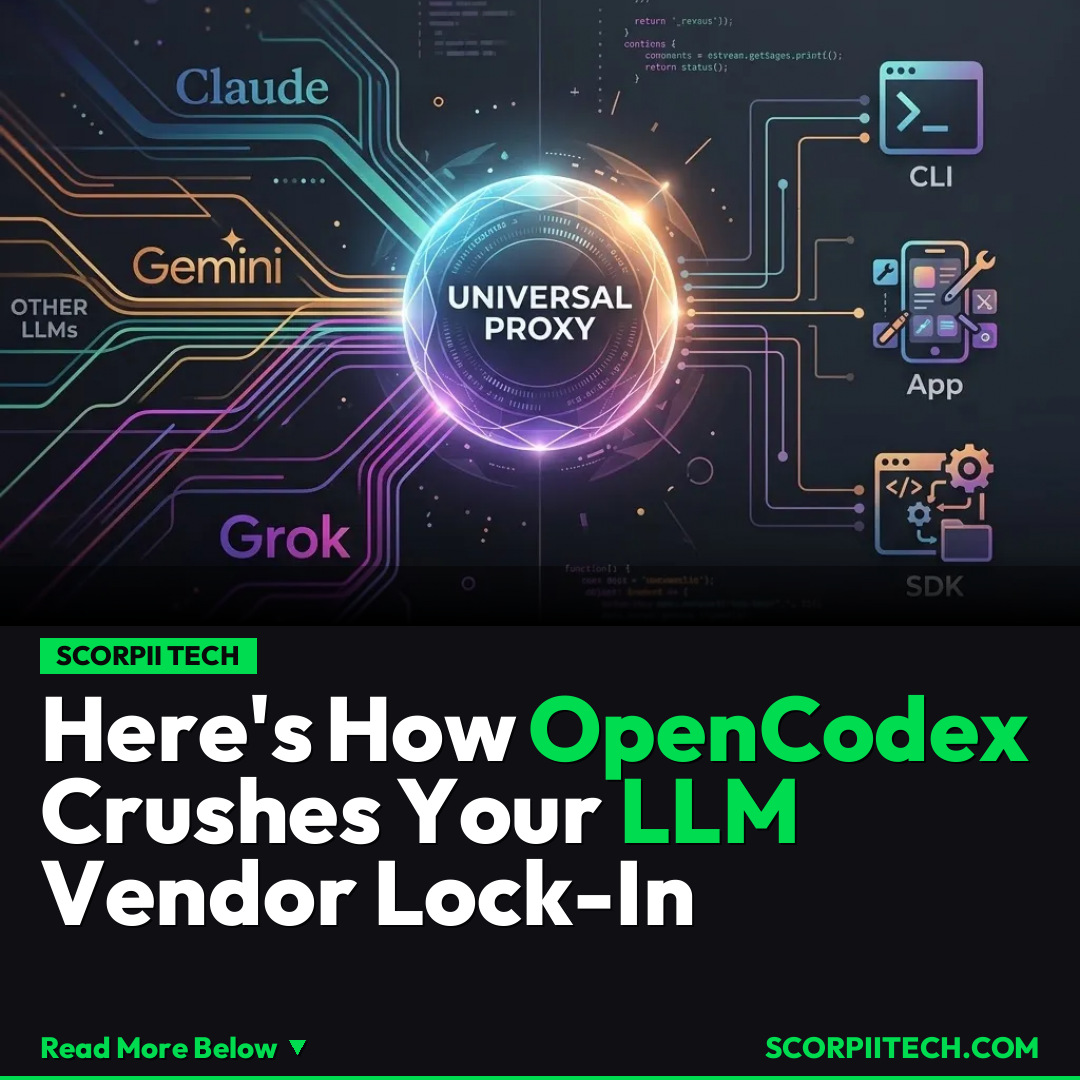
Discover lidge-jun/opencodex, the universal proxy that lets you use any LLM with your existing Codex and Claude Code tooling, finally breaking free from vendor lock-in.
Editorial Note
Reviewed and analysis by M.Numan
In this article
You know that frustrating feeling of investing time and effort into a tool, only to find yourself shackled to a single provider? In the fast-evolving world of Large Language Models (LLMs), this "vendor lock-in" has been a critical pain point, especially for developers trying to innovate. But what if you could break free and use any LLM you wanted with your existing setup? Today, that freedom arrives.
Key Details
You’ve likely experienced the frustration: you adopt a powerful AI model, integrate it deep into your workflow, and suddenly find yourself bound to that specific provider. This "vendor lock-in" forces you to rewrite code, learn new APIs, or even abandon valuable existing tooling just to experiment with or switch to a different Large Language Model (LLM). It’s a critical bottleneck for innovation and flexibility in AI development.
Deploy your next full-stack application effortlessly. Get $200 in free DigitalOcean credits to host your Docker containers, Laravel, or Python APIs.
But what if there was a universal translator for your AI tools? That's precisely what lidge-jun/opencodex delivers. This groundbreaking open-source project acts as an ingenious proxy, sitting between your established development environment and a vast array of LLMs. Imagine your OpenAI Codex CLI, App, or SDK, or your Claude Code integrations, suddenly gaining the ability to communicate with practically any LLM on the market or even locally hosted models.
Sizing Your Single-Box VPS Architecture?
Calculate exact vCPU cores, RAM GB, NVMe storage, and estimated monthly budget for your traffic before migrating away from high-cost cluster providers.
OpenCodex liberates you from the confines of single-provider ecosystems. You can now effortlessly tap into models like Claude, Gemini, Grok, DeepSeek, or even leverage the power of local models running through Ollama – all while continuing to use the very same tooling you've grown accustomed to. This isn't just about swapping out an API key; it's about a foundational shift in how you select and deploy AI. It ensures that your investment in existing development practices and infrastructure remains valuable, even as the LLM landscape continues its rapid evolution. No more wasted effort adapting to new ecosystems just to test a different model.
Why This Matters
The implications of OpenCodex are huge for you as a developer. In an industry where new LLMs with distinct advantages emerge constantly, being locked into one provider severely limits your potential. With OpenCodex, you gain unparalleled agility. You can benchmark different models for specific tasks, optimize for cost or performance without significant refactoring, and even transition to privacy-focused local models when data sensitivity is paramount. This tool doesn't just enable choices; it fosters genuine innovation by letting you mix and match the best AI components for your projects.
Furthermore, this isn't just about switching between big-name players. The ability to integrate local models via platforms like Ollama is a game-changer for accessibility and control. For small teams, researchers, or those with strict data governance requirements, running powerful LLMs on your own hardware, integrated into your existing OpenAI Codex and Claude Code workflow, opens up entirely new avenues. This democratizes access to cutting-edge AI capabilities, making advanced LLM utilization less dependent on cloud credits or external APIs and more reliant on your own strategic decisions.
The Bottom Line
Ultimately, lidge-jun/opencodex isn't just another utility; it's a statement of freedom in the AI world. If you're a developer tired of vendor lock-in, constantly adapting to new APIs, or just want more control over your LLM choices, then this tool is for you. Dive into the OpenCodex project. Explore its capabilities, contribute to its development, and start leveraging the full spectrum of LLMs with the tools you already know and love. Your AI workflow just got a massive upgrade, granting you the power to truly choose your own adventure.
What did you think?
M. Numan
Founder & Lead ArchitectM. Numan leads architecture and software engineering at ScoRpii Tech, specializing in high-throughput backend services, autonomous multi-agent AI workflows, and cross-platform mobile apps. He writes production blueprints and architectural benchmarks for modern engineering teams.
Related Articles
The Desktop App That Will Revolutionize Your AI Agent Workflow
1 month ago
Production Engineering Deep Dive: storytold/lightcraft — A Bare-Metal Blueprint for Open-Source Lightroom in 2026
5 days ago
Architecture Deep Dive: okf-memory/okf-agent-memory — Git-Native Persistent Memory for AI Coding Agents. Implement in 2026
1 week agoStay Updated
Get the latest tech news delivered to your reader.