Apple Just Killed the Mac Pro: Here's What It Means For Your Pro Workflow
Apple has officially discontinued the Mac Pro, ending an era for its high-end desktop. Understand why this niche machine failed and what its absence means for your professional setup.
Editorial Note
Reviewed and analysis by ScoRpii Tech Editorial Team.
In this article
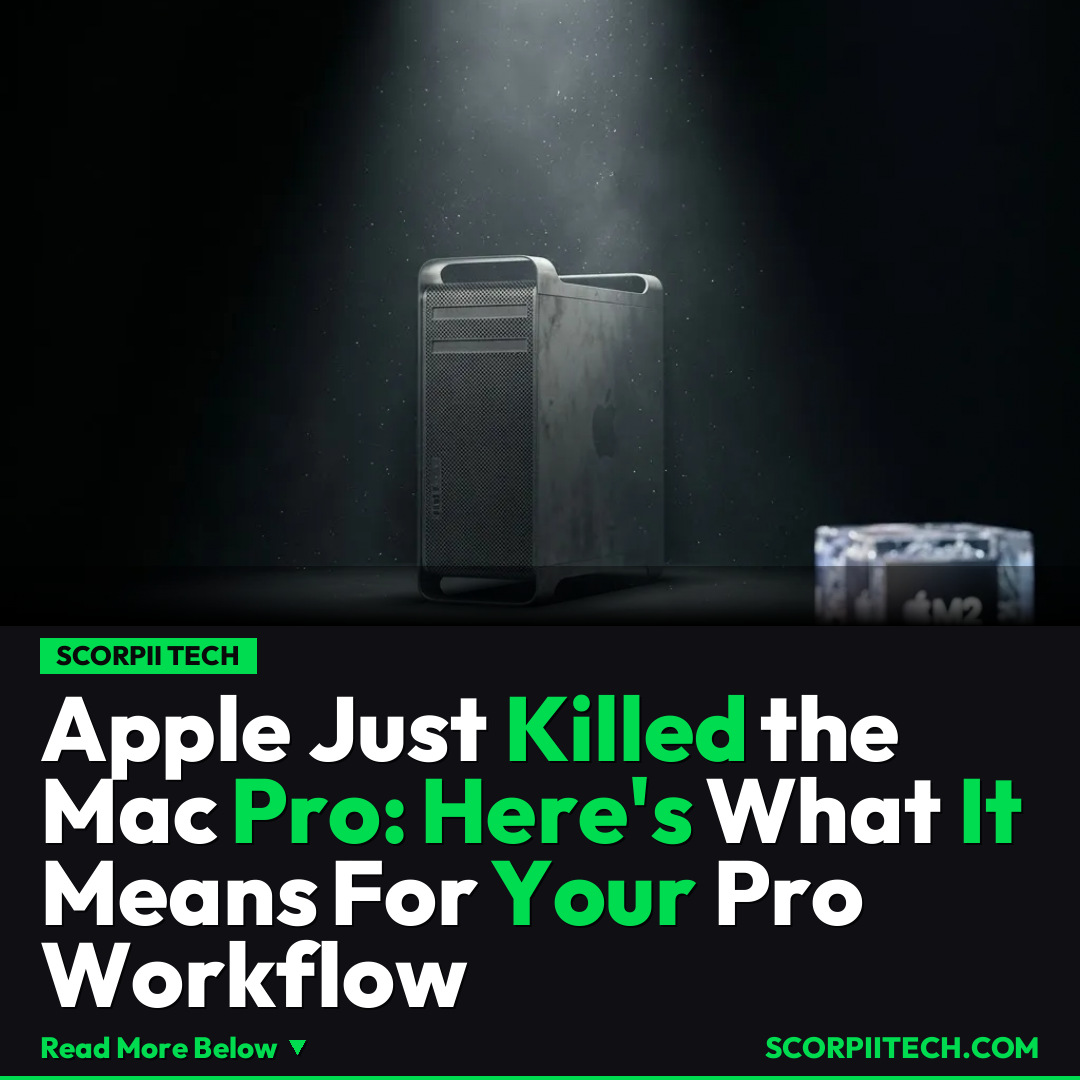
You thought Apple's Mac Pro was built for the most extreme creative workflows, a powerhouse only a select few could justify. Well, buckle up because that era is officially over. Apple has quietly confirmed to 9to5Mac that the Mac Pro is no longer available for purchase, with no plans for future hardware. It seems even Apple couldn't justify its own existence, particularly in an age dominated by its own custom silicon.
Key Details
The news arrived like a whisper, but its impact is a shout across the pro computing landscape. Apple confirmed to 9to5Mac that the Mac Pro, specifically the last iteration that retained the same design when it transitioned from Intel to Apple Silicon, has been removed from sale. You might remember this machine was always for a very specific niche, often generating controversy for being too expensive and, ultimately, not truly made for the Apple Silicon era. This means no more Mac Pro for you, and definitely no future hardware on the horizon, according to the company.
Need fast, secure, and affordable hosting for your next website or PHP application? We recommend Hostinger Managed Hosting. Get premium speeds, a free domain, and 24/7 expert support.
Let’s talk specs and pricing, because these numbers tell a story of their own. The Intel-based Mac Pro started at a cool $5,999. For that, you’d get a 3.5GHz Xeon W processor, 32GB of RAM, a Radeon Pro 580X with 8GB of GDDR5 memory, and a surprisingly modest 256GB SSD storage. If you wanted to go all out, a fully spec’d-out version could set you back an astonishing $52,199. It was a machine that commanded respect, and a seriously deep wallet.
Even with the transition to Apple Silicon, the Mac Pro remained a premium offering. The M2 Ultra Mac Pro started at $6,999, climbing up to $12,999 if you opted for the M2 Ultra chip with 8TB of SSD storage and 192GB of RAM. While powerful, many felt its modularity and price point were already being overshadowed by its smaller, more integrated sibling, the Mac Studio, which debuted with M1 Max and M1 Ultra chips, offering incredible performance at a significantly lower entry cost for many professional workflows.
Why This Matters
So, what does the demise of the Mac Pro mean for your high-end professional setup? If you've been relying on its unique PCI-E expansion capabilities or its sheer brute force, you’re now at a crossroads. The controversy surrounding its cost and its awkward fit into the Apple Silicon era means Apple is clearly signaling a new direction for its most demanding users. You're expected to look towards the Mac Studio as the new standard-bearer for powerful, yet more integrated, workflows, potentially even a maxed-out Mac mini for certain tasks.
This move highlights Apple’s confidence in its own silicon. Chips like the M1 Ultra and M2 Ultra, and the promise of future generations like the M3 Ultra, M4 Max, and M5 Ultra, are designed to deliver extraordinary performance without needing the extensive modularity and power draw of traditional workstation components. While you still have fantastic Apple displays like the Pro Display XDR and Studio Display XDR, the central processing unit is now undeniably an Apple Silicon-first consideration, consolidating power into more compact form factors and potentially saving you significant costs.
The Bottom Line
For you, the creative professional or power user, the message from San Jose, California, is clear: adapt. If your workflow heavily depended on internal expansion slots, it's time to re-evaluate external solutions or consider if the Mac Studio’s incredible power is sufficient. Apple has committed to a future where high performance comes in a more streamlined, integrated, and (for most) more cost-effective package. Your high-end computing needs are evolving, and Apple is guiding the way, even if it means saying goodbye to an old, expensive friend.
Originally reported by
BGRWhat did you think?



Stay Updated
Get the latest tech news delivered to your reader.