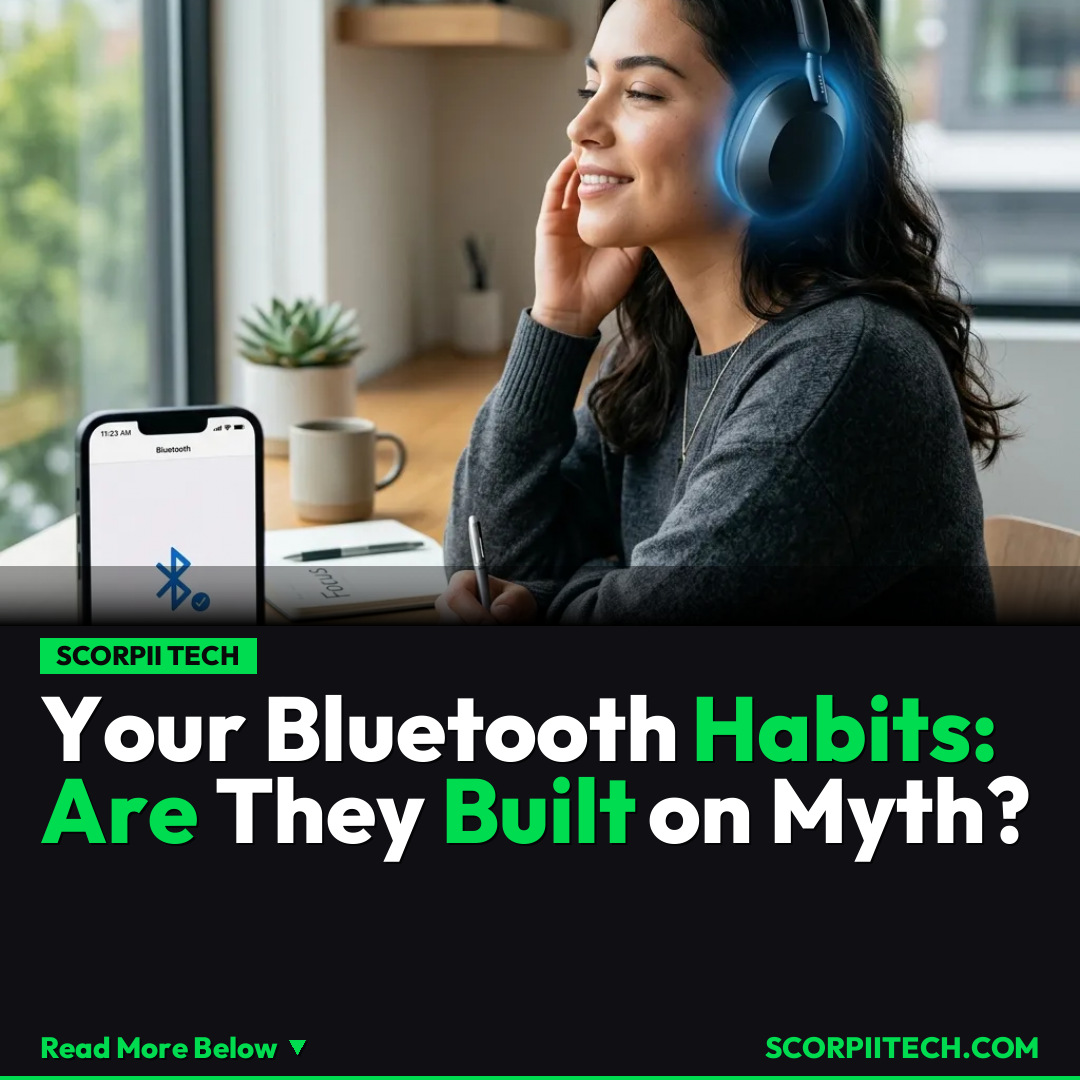
Your Bluetooth Habits: Are They Built on Myth?
Don't let old wives' tales about Bluetooth hold you back. Discover the truth behind common Bluetooth myths and how modern tech has evolved to enhance your wireless experience.
Editorial Note
Reviewed and analysis by ScoRpii Tech Editorial Team.
In this article
Remember wrestling with tangled AUX cables just to listen to music? Those days are long gone, thanks to ubiquitous Bluetooth technology. But while your wireless world has evolved, your understanding of Bluetooth might be stuck in the past. It’s time to unravel the common misconceptions holding you back from truly embracing wireless freedom.
Key Details
You've probably heard it all: Bluetooth drains your phone battery too fast, or it's constantly radiating harmful waves. These are among the common Bluetooth misconceptions that expert analyses, like those from Android Authority, consistently debunk. Modern Bluetooth isn't the battery hog you remember from early iterations. With significant advancements in wireless communication, Bluetooth has become remarkably efficient, especially with the introduction of Bluetooth Low Energy (LE) standards.
Need fast, secure, and affordable hosting for your next website or PHP application? We recommend Hostinger Managed Hosting. Get premium speeds, a free domain, and 24/7 expert support.
Specifically, versions like Bluetooth 4.0 and the more recent Bluetooth 5.0 have revolutionized power consumption. Bluetooth LE allows devices to maintain a connection while using a fraction of the power of older versions, making it ideal for everything from smartwatches to wireless earbuds. You might notice your phone's Wi-Fi often uses more power than your always-on Bluetooth. This efficiency is further bolstered by features like Long Range BLE and Coded PHY in Bluetooth 5.0, extending range without a proportional increase in energy demand.
Then there's the concern about radiation. It's a persistent fear, but experts provide clarity: Bluetooth uses non-ionizing radiation. As one expert succinctly puts it, "Non-ionizing radiation is too weak to have ionizing effects." This means it doesn't have enough energy to damage your DNA or cause cancer, unlike ionizing radiation (e.g., X-rays). Your Wi-Fi router, cordless phone, and even the sun emit more powerful forms of non-ionizing radiation than your Bluetooth headphones or smartwatch. So, you can put those fears to rest; your devices are not silently irradiating you.
Why This Matters
Why should you care about these Bluetooth myths? Because these misconceptions might be limiting your device usage and causing unnecessary worry. You might be manually toggling Bluetooth off and on, thinking you're saving significant battery life, when in reality, the power savings are negligible compared to the inconvenience. You could be missing out on seamless connections with multiple devices, quicker pairing, and the enhanced stability that modern Bluetooth 5.0 offers across your smart home or personal tech ecosystem.
Understanding the true capabilities and limitations of Bluetooth means you can make more informed decisions about your tech. You can trust your wireless earbuds to last through your commute, rely on your smartwatch to stay connected all day, and stop worrying about imaginary health risks. Knowing the facts empowers you to fully leverage the convenience and innovation that wireless technology provides, streamlining your digital life rather than adding friction due to outdated fears.
The Bottom Line
In a world where wireless is the norm, it's essential to update your knowledge alongside your devices. You should stop falling for old Bluetooth myths. Embrace the efficiency of Bluetooth Low Energy and the robust features of Bluetooth 5.0. Keep your Bluetooth on, enjoy uninterrupted connectivity, and rest assured that you're using a safe, energy-conscious technology. The future is wireless, and for you, it should also be worry-free.
Originally reported by
BGRWhat did you think?

Stay Updated
Get the latest tech news delivered to your reader.