Here's Why Your EV Could Power Your Home (and What Tesla's Doing)
Discover how modern electric vehicles are revolutionizing home power, offering backup during outages. Learn which EVs support "bidirectional charging" and what it means for you.
Editorial Note
Reviewed and analysis by ScoRpii Tech Editorial Team.
In this article
You’re sitting in the dark during a power outage, looking at your sleek electric vehicle parked in the driveway. A natural question sparks: why can't that massive battery on wheels power your home right now? It’s a dream rapidly becoming reality for many, thanks to a game-changing technology called "bidirectional charging." This innovation transforms your EV from a simple mode of transport into a vital energy hub for your household.
Key Details
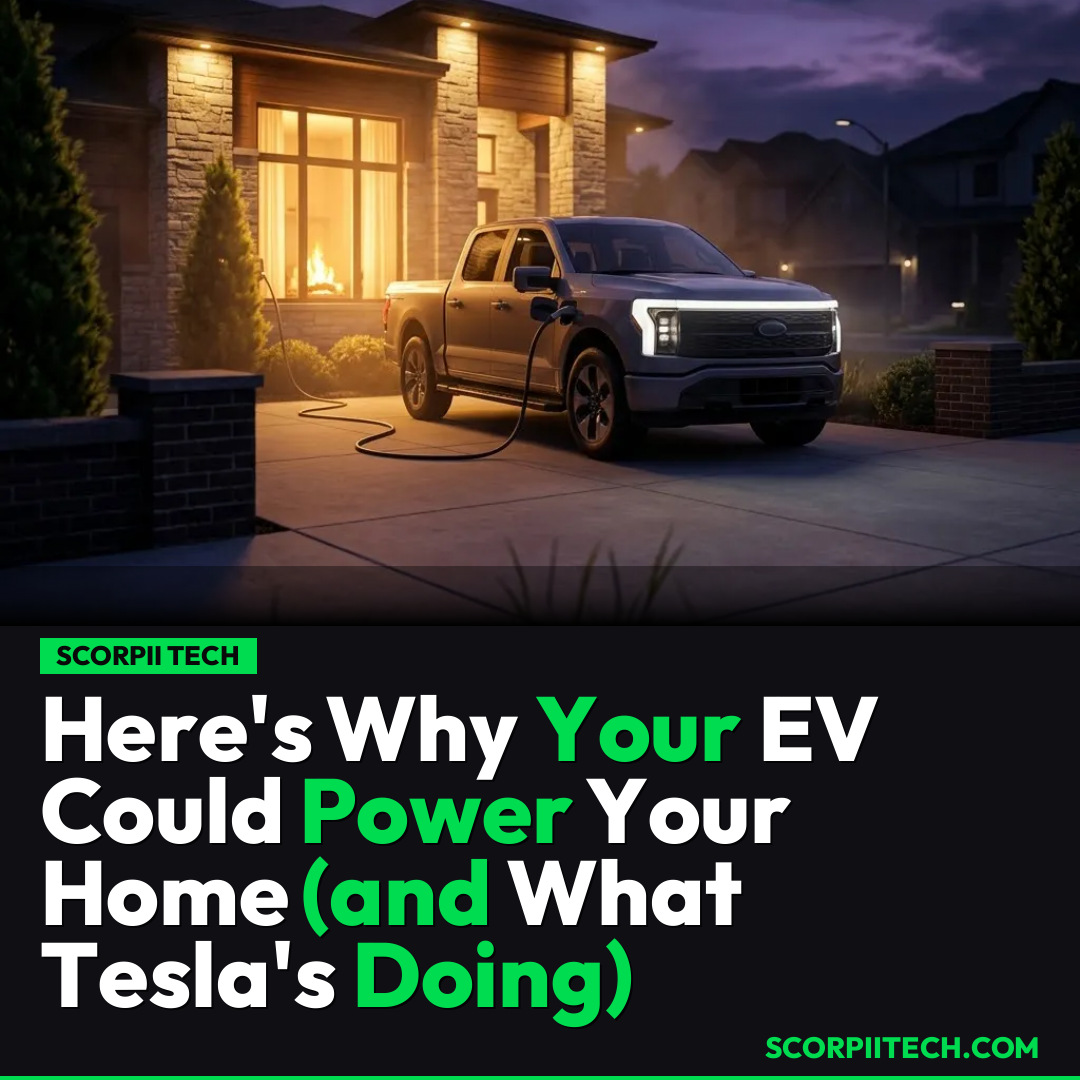
The core innovation is "bidirectional charging," allowing your EV to not only consume power from the grid but also send it back to your home, effectively transforming your vehicle into a giant mobile battery pack. While you might expect your Tesla to offer this, many other brands are already leading the way in home backup. For instance, the Ford F-150 Lightning, though discontinued in 2025, demonstrated its extended battery could power an average home for up to three days. Ford famously stated the Lightning held "as much energy as 7 Tesla Powerwalls," underscoring its practical benefits.
Need fast, secure, and affordable hosting for your next website or PHP application? We recommend Hostinger Managed Hosting. Get premium speeds, a free domain, and 24/7 expert support.
Beyond Ford, a growing number of vehicles offer or will offer similar capabilities. You'll find the Hyundai Ioniq 5 and Ioniq 6 (E-GMP platform, 3.6 kW), Kia’s EV6 and EV9 (E-GMP), and Chevrolet's Silverado EV (Ultium platform, 9.6 kW). Even the Nissan Leaf, an EV pioneer available since 2010 (related models 2009, 2013, 2022), has featured this technology. Looking ahead, the Polestar 3 is expected in 2025, and significantly, the Tesla Cybertruck now boasts "Powershare," confirming Tesla's official entry into the bidirectional charging arena.
Why This Matters
This isn't just a cool tech demo; it fundamentally changes how you might view your vehicle. In a world increasingly prone to unpredictable weather and grid instability, your EV acting as a crucial home backup provides invaluable peace of mind. You’re not just buying a car; you’re investing in a mobile power solution that can keep essential appliances running, devices charged, and your family safe. This points towards greater energy independence, allowing you to charge your car during off-peak hours and use that stored energy during peak demand, potentially saving you money. Your car can become a dynamic participant in your home's energy ecosystem, pushing beyond simple transportation.
The Bottom Line
When you’re considering your next electric vehicle purchase, it’s time to expand your checklist beyond just range and charging speed. Ask yourself: can this car power my home? With "bidirectional charging" becoming more common, your EV isn't just about getting from point A to point B; it's about providing security, flexibility, and potentially even savings for your entire household. This isn't a futuristic concept; it's a rapidly evolving reality that could redefine your relationship with both your car and your home's power supply.
Originally reported by
BGRWhat did you think?


Stay Updated
Get the latest tech news delivered to your reader.