OpenAI's 80-Year Math Breakthrough: What You Need To Know
OpenAI's new reasoning model claims to have disproved an 80-year-old math conjecture by Paul Erdős. Discover why this controversial claim matters for your future in tech.
Editorial Note
Reviewed and analysis by ScoRpii Tech Editorial Team.
In this article
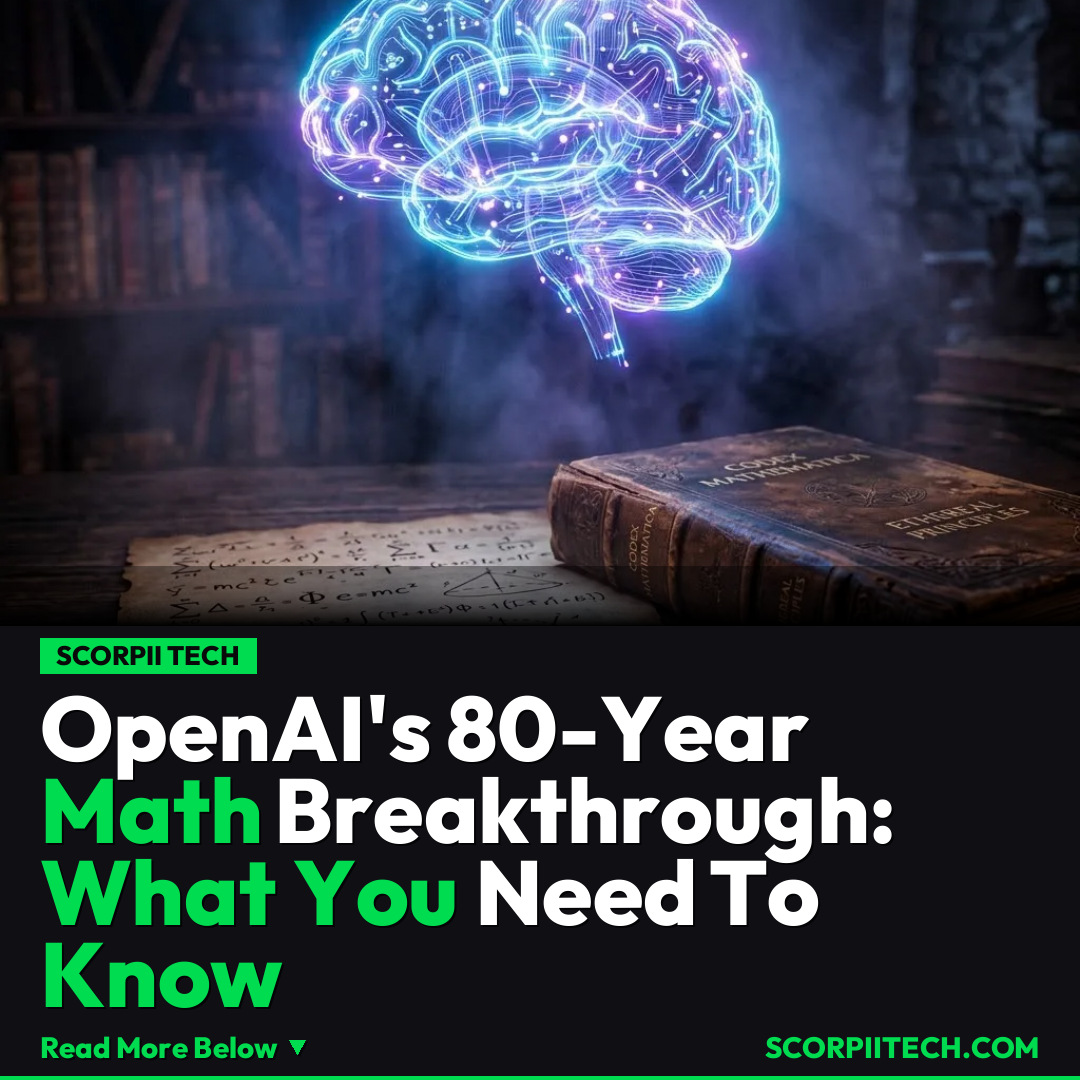
Imagine tackling a puzzle that has stumped brilliant minds for eight decades – a true Everest of geometry, first posed by the legendary Paul Erdős in 1946. Now, OpenAI says its new reasoning model has produced an original mathematical proof disproving this famous unsolved conjecture. You might be wondering if this is the real breakthrough you've been promised, especially given past controversies.
Key Details
You’re looking at a claim so significant, it could redefine AI’s role in scientific discovery. OpenAI, according to a report from StrictlyVC, asserts its latest reasoning model has crafted an original mathematical proof. This proof reportedly disproves a famously difficult, unsolved conjecture in geometry. The problem itself dates back to 1946, initially posed by the prolific Hungarian mathematician Paul Erdős. This puzzle has resisted solutions from countless human minds for over 80 years.
Need fast, secure, and affordable hosting for your next website or PHP application? We recommend Hostinger Managed Hosting. Get premium speeds, a free domain, and 24/7 expert support.
What makes this particularly interesting – and a little controversial – is OpenAI's track record. You might recall previous instances where their bold claims in mathematical breakthroughs were met with significant skepticism and even outright dispute. This context adds an extra layer of scrutiny to their current assertion. However, proponents argue that this is precisely how progress happens. As one quote suggests, "AI is helping us to more fully explore the cathedral of mathematics we have built over the centuries," hinting at a future where AI acts as a powerful guide in uncovering deeper truths.
Why This Matters
You might be asking, "Why does a complex geometry proof from 1946 matter to me?" If an AI can genuinely produce original mathematical proofs that overturn long-standing conjectures, it signals a profound shift in how we approach problem-solving across every field. This isn't just about crunching numbers faster; it's about AI demonstrating an unprecedented level of abstract reasoning and creative thought, skills once considered uniquely human. Your future, whether in science, engineering, or even daily decision-making, could be profoundly influenced by machines that can reason and innovate at this level.
Think about the implications for scientific research: AIs could become indispensable partners in areas like theoretical physics, drug discovery, or climate modeling, accelerating breakthroughs we can only dream of today. This isn't just about automation; it's about augmentation of human intellect. While the debate around AI's "understanding" will undoubtedly continue, its proven ability to navigate and expand the "cathedral of mathematics" suggests a future where the limits of human knowledge are continually pushed, not just by our own brilliance, but by the intelligent systems we create. This development could pave the way for entirely new forms of discovery that were previously unreachable.
The Bottom Line
So, what's your takeaway here? While the full verification of OpenAI's claim is still unfolding – and given past controversies, a healthy skepticism is warranted – this announcement marks a pivotal moment. You should stay tuned to developments in AI research, recognizing that the ability of these systems to tackle complex, abstract problems is rapidly evolving. This isn't just a headline for mathematicians; it's a window into the future of scientific exploration and the ongoing partnership between human ingenuity and artificial intelligence. Keep an eye on how these advanced reasoning models evolve; they might just redefine what's possible, right before your eyes.
Originally reported by
TechCrunchWhat did you think?


Stay Updated
Get the latest tech news delivered to your reader.