Why Your USB-C Cable Charges Slower Than You Think
Unlock the mystery of USB-C cable charging speeds. Discover why your cables differ and what wattage you need for optimal fast charging.
Editorial Note
Reviewed and analysis by ScoRpii Tech Editorial Team.
In this article
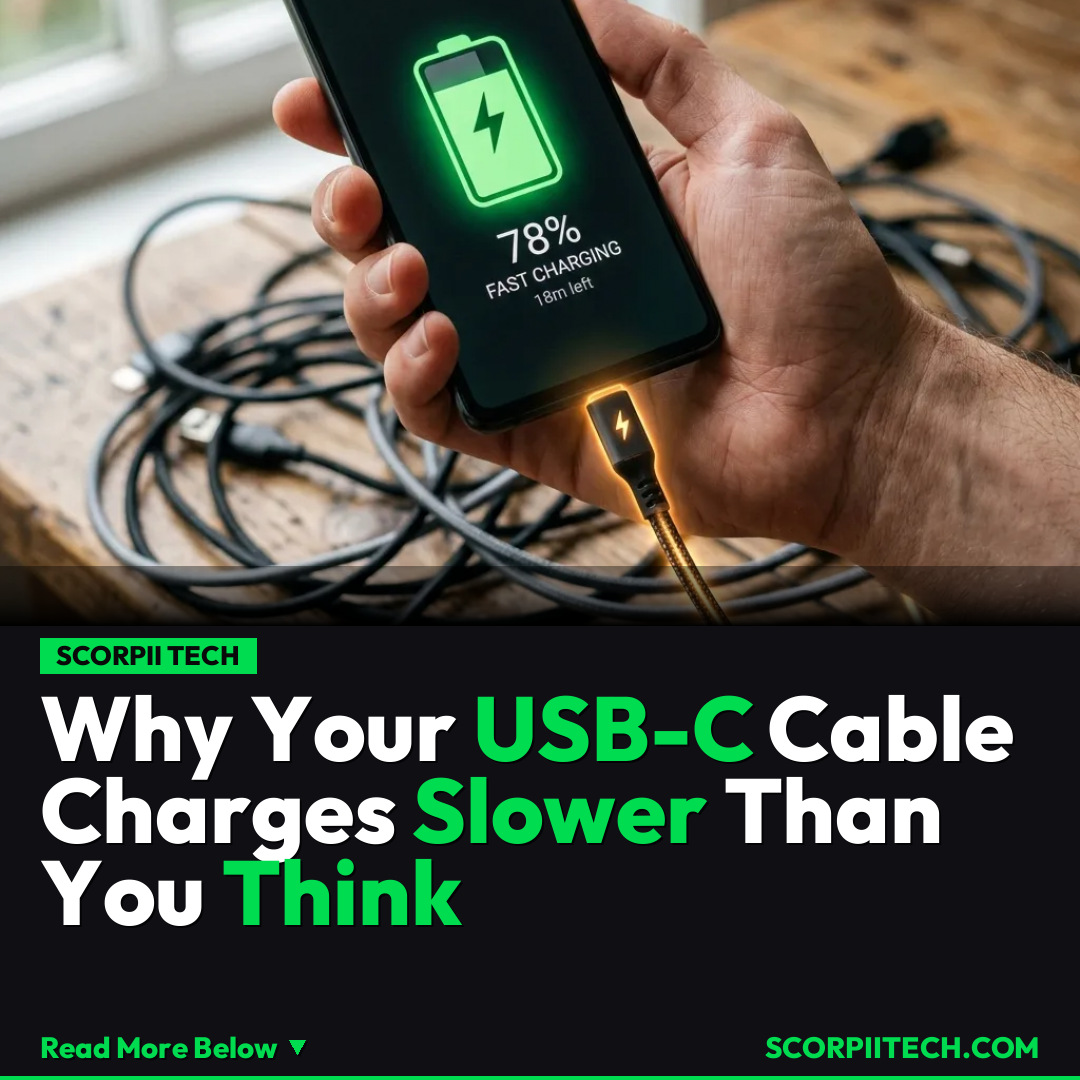
Have you ever plugged a fast-charging-capable device, like a smartphone, into a USB-C cable that only charges slowly? You’re not alone if you’ve felt that frustration. The confusion around USB-C cables and their charging speeds is a common pain point for many tech users, despite their universal design. It's a common trap that can leave you waiting longer than necessary for your devices to power up, purely due to an overlooked detail.
Key Details
You might think all USB-C cables are the same, but the reality is far more complex. The standard USB Type-C connector is widely adopted, but what’s inside the cable varies dramatically. For instance, an older USB-C 2.0 cable might only support data transfer speeds up to 480Mbps and much lower power delivery. While this might be fine for some basic tasks, it’s certainly not enough to keep pace with today's power-hungry gadgets and fast-charging technologies.
Need fast, secure, and affordable hosting for your next website or PHP application? We recommend Hostinger Managed Hosting. Get premium speeds, a free domain, and 24/7 expert support.
The real magic happens with Power Delivery (PD) and higher-spec cables. While earlier iterations of USB-C PD could deliver up to 100-watts, newer cables are designed to handle a staggering up to 240-watts, allowing for significantly faster charging of laptops, tablets, and even some monitors. For your devices to truly fast-charge, you'll generally need cables and chargers capable of delivering 18-watts or higher. For optimal performance with many modern smartphones and smaller laptops, you're looking at a 40-watt to 65-watt charger and a compatible cable to unlock those rapid charge times. Understanding these specifications is key to maximizing your device's potential.
Entities like USB 3.2 Gen 1, USB 3.2 Gen 2, USB 3.2 Gen 2x2, USB 4, and Thunderbolt further complicate the picture, as these also denote differing data transfer rates and often, implicitly, power capabilities. The USB Implementers Forum (USB-IF) is the organization behind these standards, aiming for uniformity, yet the sheer variety in cable performance under the same "USB-C" label continues to sow confusion among consumers.
Why This Matters
This technical nuance directly impacts your daily life and productivity. Imagine buying a brand-new smartphone advertised with "super-fast charging," only to find it still takes hours to fully charge. This frustration often isn’t with your device or charger, but with the bottleneck created by an inadequate cable. You're effectively leaving significant performance on the table simply because the cable connecting your device to its power source isn’t up to the task. It's about ensuring your investment in fast-charging technology isn't undermined by a seemingly minor accessory.
Understanding these differences means you can make informed purchasing decisions, saving you time and preventing that annoying "low battery" anxiety. You deserve to get the most out of your tech, and a simple cable choice can drastically alter your experience, from how quickly your laptop powers up before a meeting to how soon your phone is ready for your next adventure.
The Bottom Line
Don't let the visual similarity of USB-C cables fool you. To ensure your devices charge as quickly as they're capable, you need to pay attention to the specifications. Always check the wattage a cable supports, as well as any associated USB data standards like USB 3.2 Gen 2 or USB 4, to ensure it matches your charger and device’s fast-charging requirements. Prioritize cables rated for 40-watt to 65-watt charging or higher if your devices demand it. By being a savvy shopper, you can eliminate slow charging frustrations and keep your tech running at peak performance.
Originally reported by
BGRWhat did you think?


Stay Updated
Get the latest tech news delivered to your reader.