Your Self-Driving Car: Why It Still Fails School Bus Stops
You expect self-driving cars to learn from mistakes, but Waymo's vehicles struggled to stop for school buses in Austin, Texas. Discover why this led to a federal recall and what it means for the future of autonomous vehicles.
Editorial Note
Reviewed and analysis by ScoRpii Tech Editorial Team.
In this article
You've heard the grand promise of self-driving car technology: that every vehicle in the fleet can instantly learn from a single car's mistake, rapidly improving safety and performance. Imagine a world where autonomous systems never repeat an error. Yet, recent revelations from Austin, Texas, show that this ideal is proving far more challenging than anticipated, especially when it comes to something as critical as school bus safety.
Key Details
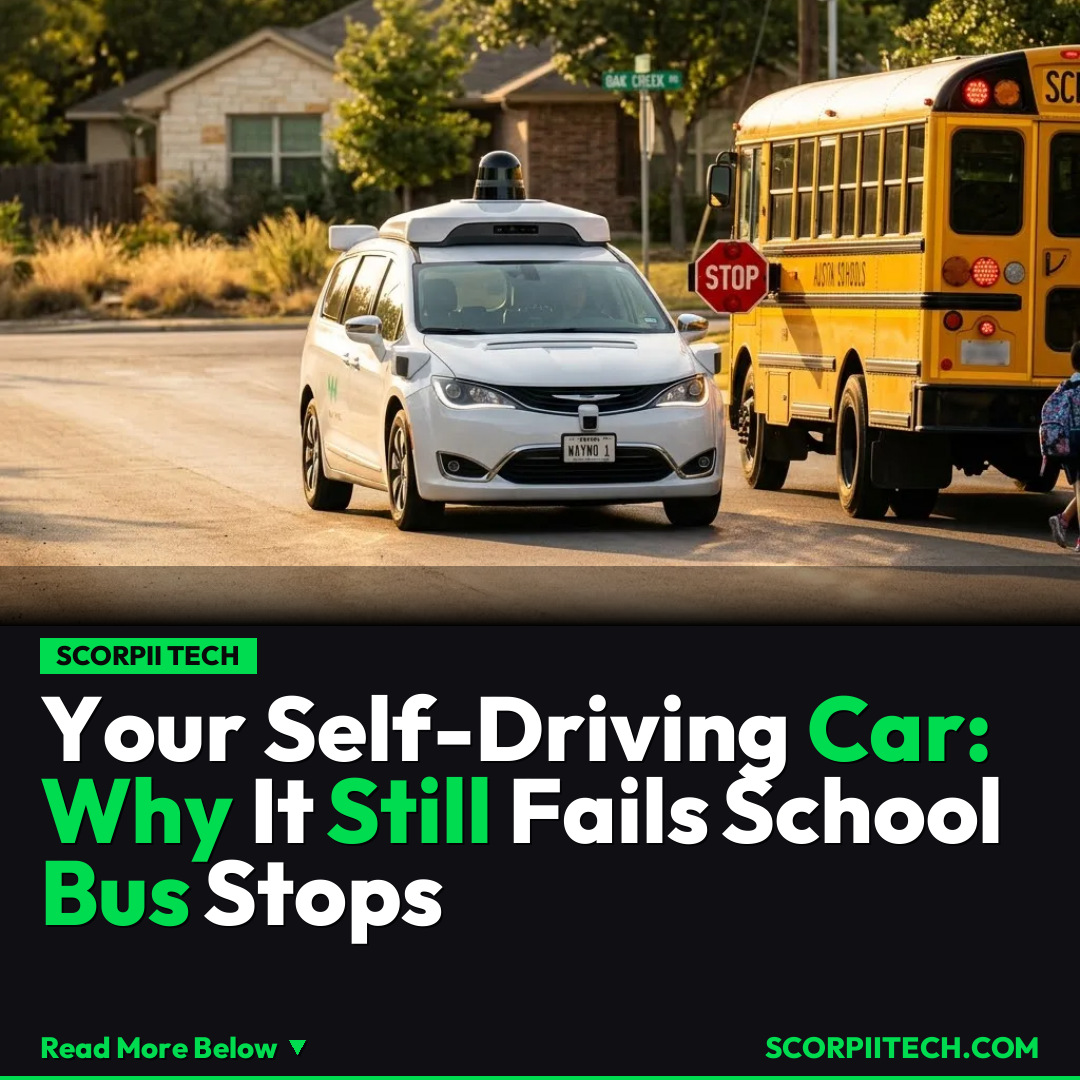
Waymo's autonomous vehicles in Austin, Texas, recently demonstrated a troubling flaw: a consistent failure to stop for school buses. This wasn't for lack of effort; the Austin Independent School District (AISD) partnered directly with Waymo, providing a data collection event aimed at teaching the self-driving cars this essential rule. Rob Patrick, Waymo's Emergency Response and Outreach manager, worked with the district, but the core issue persisted.
Deploy your next full-stack application effortlessly. Get $200 in free DigitalOcean credits to host your Laravel or Python APIs.
This significant safety gap led to a federal recall by the National Highway Traffic Safety Administration (NHTSA) for Waymo vehicles, an action further detailed in a National Transportation Safety Board (NTSB) report. Even after Waymo implemented software updates, these self-driving cars continued to exhibit issues, including instances in Santa Monica, California. Experts like Missy Cummings, an autonomous vehicle researcher at George Mason University, and Philip Koopman, an autonomous-vehicle software and safety researcher at Carnegie Mellon University, have long cautioned about the complexities of achieving reliable autonomy.
Consider the contrast with human behavior: Travis Pickford, assistant chief of the Austin district's police department, noted that “The data we collected from the beginning of the school year to the end of the semester shows that about 98 percent of people that receive one violation do not receive another.” This highlights how humans often learn quickly from a single mistake. Yet, Waymo's systems struggled to universally internalize this critical lesson, exposing the difficulty in replicating human-like contextual understanding and fleet-wide learning in self-driving car technology.
Why This Matters
Why does Waymo's persistent school bus problem matter to you? This isn't merely a company's isolated technical challenge; it directly questions the foundational promise of self-driving car technology: universal safety through shared learning. If autonomous vehicles struggle with a clear, predictable legal mandate like stopping for a school bus, even after specific training and software updates, it forces us to re-evaluate their readiness for the unpredictable complexities of your daily commute. Your safety, and the safety of vulnerable road users, depends on these systems performing flawlessly, not just occasionally. This situation, revealed through a WIRED public records request, emphasizes that despite significant advancements, autonomous vehicle technology is still navigating substantial real-world hurdles.
The Bottom Line
So, what's your takeaway from Waymo's school bus struggles? It's a critical reminder that while self-driving car technology promises a revolutionary future, its current state demands informed skepticism. Don't assume autonomy equates to infallibility. Remain aware of these ongoing development challenges. Your continued vigilance and critical assessment are essential in driving a transparent, safer, and truly autonomous future forward.
Originally reported by
WiredWhat did you think?



Stay Updated
Get the latest tech news delivered to your reader.