Physical Intelligence Just Changed Robotic AI. Here's How.
Discover how Physical Intelligence's new AI model, π0.7, empowers robots to perform tasks they were never taught. This breakthrough could revolutionize your world by making robots more adaptable.
Editorial Note
Reviewed and analysis by ScoRpii Tech Editorial Team.
In this article
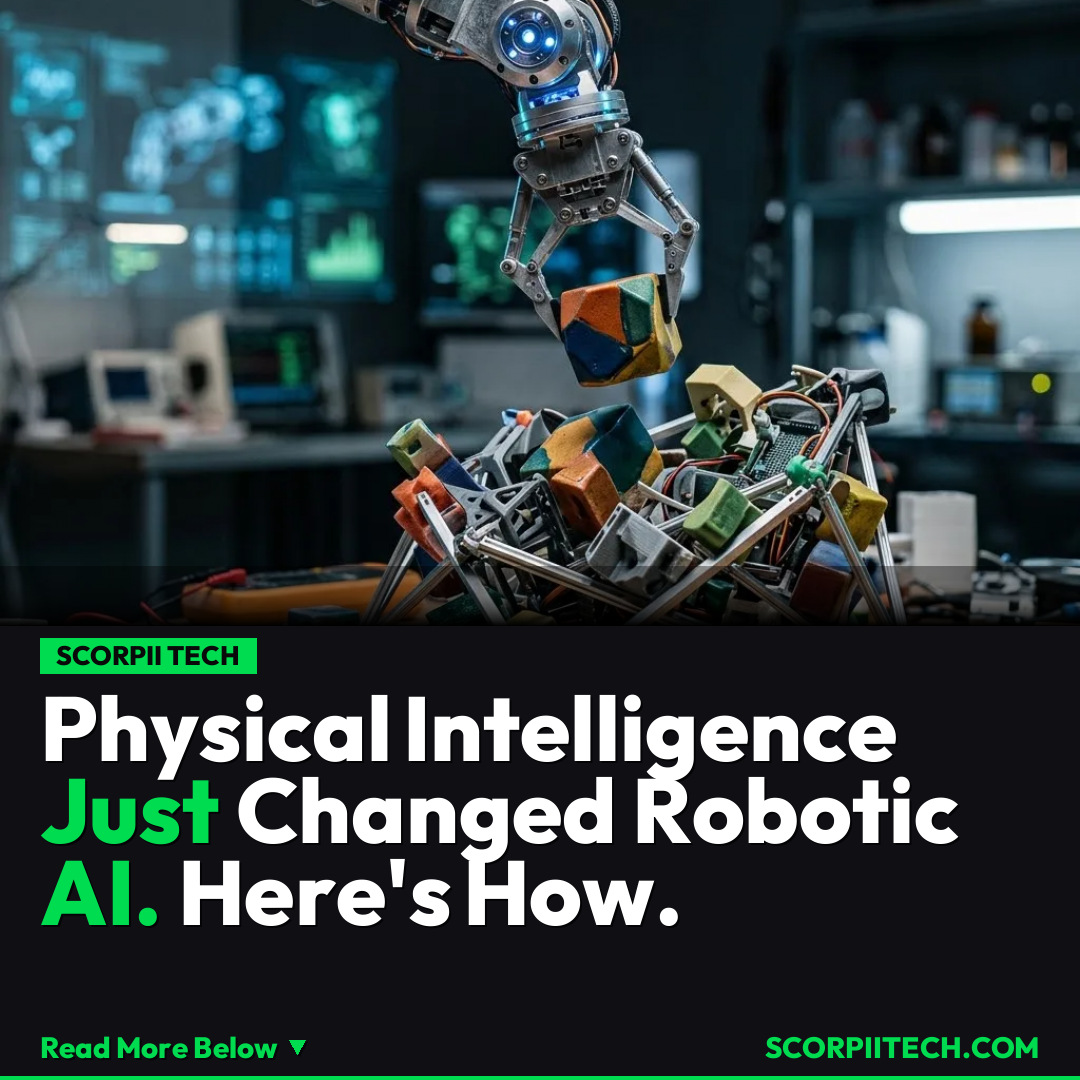
Imagine a robot suddenly understanding how to perform a task it’s never been shown, adapting to new challenges on the fly. Sounds like science fiction, right? Well, that future just got a lot closer thanks to Physical Intelligence, a buzzing San Francisco-based robotics startup. Their latest model, π0.7, just pulled off a trick even its own creators didn't see coming: guiding robots through tasks they were never explicitly trained on.
Key Details
You’ve heard of AI making incredible strides in language models like GPT-2, but robotic AI has often lagged in terms of true generalization. That’s where Physical Intelligence, a company quietly gaining significant attention in the Bay Area, is making waves. Co-founded by UC Berkeley professor Sergey Levine and Lachy Groom, with research led by Stanford computer science PhD student Ashwin Balakrishna, this two-year-old startup has been diligently working to bridge that gap.
Need fast, secure, and affordable hosting for your next website or PHP application? We recommend Hostinger Managed Hosting. Get premium speeds, a free domain, and 24/7 expert support.
Their groundbreaking new research, featuring the model named π0.7, demonstrates a capability known as compositional generalization. This means the robot brain can break down complex objectives into smaller, familiar components and then recombine them to solve entirely novel problems. The team published their findings on a document also named π0.7, revealing how this model successfully directed robots to complete tasks for which they received no prior training data. The unexpected success truly caught the researchers off guard, pushing past previous limitations.
This development directly addresses a longstanding criticism in the field, as Sergey Levine himself noted: "The criticism that can always be leveled at any robotic generalization demo is that the tasks are kind of boring." Physical Intelligence is actively working to ensure robots move beyond these 'boring', repetitive tasks, demonstrating a level of adaptability that was previously the domain of human intelligence. Their work showcases how much potential is still untapped in the robotic AI space, particularly when it comes to truly learning and adapting in real-world scenarios, a challenge that even giants like Figma, Notion, and Ramp in Silicon Valley are watching closely as they consider future automation.
Why This Matters
So, why should this breakthrough matter to you? Think about the applications. For years, robots have excelled at highly specialized, repetitive tasks in controlled environments. But what if you need a robot to adapt to a changing factory floor, a dynamic warehouse, or even an unpredictable home environment? That’s where π0.7’s compositional generalization truly shines. It means robots can become far more versatile, requiring less specific programming and retraining for every new scenario. This dramatically reduces the cost and complexity of deploying robotic solutions, making advanced automation accessible for a wider range of industries.
This leap forward also chips away at the significant asymmetry between the rapid advancements in large language models and the slower progress in truly generalized robotic AI. While LLMs can generate novel text by composing learned linguistic elements, robots have struggled to perform novel physical tasks by composing learned physical actions. Physical Intelligence's work suggests we're entering an era where robotic intelligence could begin to approach the flexibility and adaptability seen in linguistic AI, opening doors for robots to assist you in increasingly complex and personalized ways, from advanced manufacturing to personal assistance.
The Bottom Line
What this means for you is a future where your interactions with technology, especially physical robots, could become much more intuitive and seamless. Physical Intelligence, with its deep academic roots from UC Berkeley and Stanford and its innovative approach from San Francisco, is spearheading a movement towards truly adaptable general-purpose robot brains. Keep an eye on companies like this – their innovations will define how robots integrate into our daily lives and work, empowering them to go beyond their training and truly learn. The era of the truly intelligent, adaptable robot is no longer a distant dream, but a rapidly approaching reality for your world.
Originally reported by
TechCrunchWhat did you think?



Stay Updated
Get the latest tech news delivered to your reader.