Your Clinical AI Doesn't Need CUDA: Training MedQA on AMD ROCm
Discover how the MedQA project successfully fine-tuned a clinical AI on AMD ROCm, proving you don't need CUDA for advanced medical AI workloads.
Editorial Note
Reviewed and analysis by ScoRpii Tech Editorial Team.
In this article
Challenging CUDA Dominance in Clinical AI
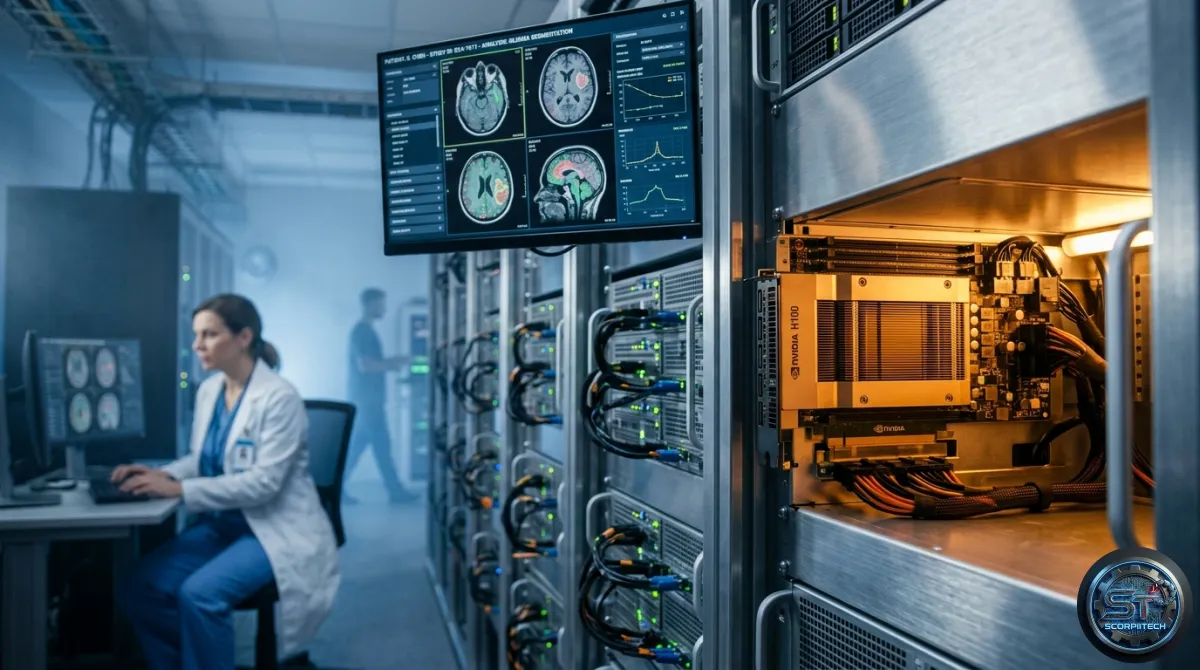
Your default assumption for deploying or developing advanced AI, particularly for demanding applications like clinical diagnostics, no longer has to involve NVIDIA hardware and its proprietary CUDA programming model. The recent MedQA project directly confronts this paradigm, showcasing a complete training pipeline for a capable, explainable medical AI running entirely on an AMD Instinct MI300X system without a single CUDA dependency.
This project demonstrates that fine-tuning a Qwen3-1.7B model to excel at Indian medical entrance exams, including USMLE-style questions, is not only possible but straightforward on AMD's open-source ROCm platform. Harikrishna Sivanand Iyer and Srijan Sivaram A, who worked on the project, emphasize the practical value, stating, “The model doesn't just output a letter — it explains why, which is what makes it clinically useful.”
Need fast, secure, and affordable hosting for your next website or PHP application? We recommend Hostinger Managed Hosting. Get premium speeds, a free domain, and 24/7 expert support.
The Underlying Mechanism: LoRA and Parameter Efficiency
The efficiency and adaptability of the MedQA fine-tuning process owe much to its strategic use of LoRA (Low-Rank Adaptation) via the PEFT (Parameter-Efficient Fine-Tuning) library. If you're managing large language models, training a full 1.5 billion parameter model for specific tasks can be resource-intensive and time-consuming. LoRA is a technique designed to significantly reduce the number of trainable parameters during fine-tuning of large pre-trained models.
Instead of modifying all existing weights of a large model, LoRA injects small, trainable low-rank matrices into select layers. These low-rank matrices represent changes to the original weights. When you perform inference, the fine-tuned low-rank matrices are added to the original pre-trained weights. This method isolates the new, task-specific parameters, allowing you to fine-tune effectively with substantially fewer computational resources and memory.
Key Benefits of LoRA
The benefits of using LoRA include:
- Reduced number of trainable parameters, resulting in faster fine-tuning times and lower computational costs.
- Improved model performance on downstream tasks, thanks to the ability to adapt to new data without requiring full retraining.
- Enhanced model interpretability, as the fine-tuned low-rank matrices provide insights into how the model is making predictions.
Operational Impact and Your Infrastructure Strategy
The MedQA project's success on AMD ROCm presents a concrete alternative to an NVIDIA-dominated ecosystem. For you as a DevOps engineer or systems architect, this widens your options for hardware procurement and operational strategy. Breaking away from a single vendor can mitigate supply chain risks, reduce hardware acquisition costs, and foster competition in the GPU market, potentially lowering your overall TCO for AI compute.
What This Means For You
Your previous assumptions about the hardware requirements for cutting-edge clinical AI development now need re-evaluation. The MedQA project confirms that you possess a viable, high-performance path for building and deploying explainable medical AI systems using AMD's open-source ROCm platform.
The Bottom Line for Developers
In conclusion, the MedQA project demonstrates the feasibility of using AMD Instinct MI300X for clinical AI workloads, leveraging familiar open-source tooling from HuggingFace. This flexibility could be crucial when scaling your AI initiatives, especially for specialized applications like those in the medical field where explainability and robust performance are non-negotiable.
Originally reported by
Hugging Face BlogWhat did you think?



Stay Updated
Get the latest tech news delivered to your reader.