MacBook Neo vs. Air: Why You Should Rethink That $500 Saving
Confused between the new MacBook Neo and the MacBook Air? We break down the key differences and reveal why that $500 price gap might be misleading you when making your next tech purchase.
Editorial Note
Reviewed and analysis by ScoRpii Tech Editorial Team.
In this article
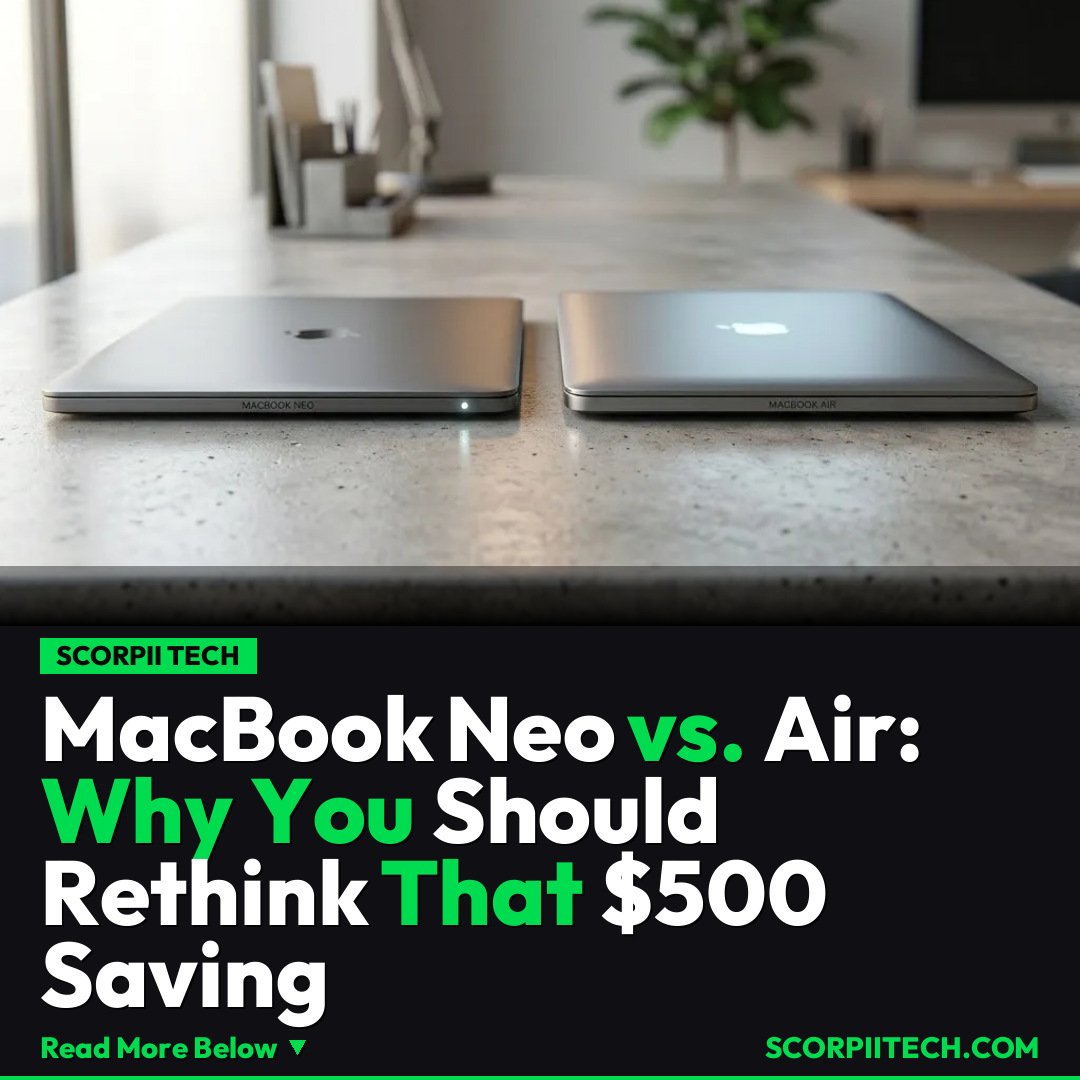
You’ve seen the price tag: $500. That's the tempting difference between the brand-new MacBook Neo and the familiar MacBook Air. It sounds like a steal, right? But before you reach for your wallet, a crucial question hangs in the air: is Apple really offering you a genuine upgrade or a compromise that might cost you more in the long run? Let’s break down the hidden truths.
Key Details
Let's talk specs, because this is where the plot thickens. The new MacBook Neo steps onto the scene with a 13-inch display, powered by Apple’s A18 Pro chip, and comes with 8 GB of memory, all for a tempting $699. On paper, it looks like a budget-friendly entry into the MacBook ecosystem, perhaps aimed at tempting users away from Windows laptops, Chromebooks, or even Linux distributions with an affordable Apple badge.
Deploy your next full-stack application effortlessly. Get $200 in free DigitalOcean credits to host your Laravel or Python APIs.
However, when you pivot to the MacBook Air, things start to look significantly different. For $1,099 – that $500 extra – you're getting a slightly larger 13.6-inch display, a more powerful M5 chip, and a substantial 16 GB of memory. That’s double the memory of the Neo, and an M-series chip versus an A-series. This isn't just a minor bump; it's a fundamental difference in architecture and raw performance capabilities that directly impacts your daily experience.
It's no wonder, then, that the conversation around these two machines is already heating up. You might even have heard the stark warning from some in the know: "Don't bother considering the MacBook Neo." This isn't just a casual dismissal; it's a strong indication that the perceived value of the Neo might not align with its real-world performance or longevity, especially when compared to its immediate sibling.
Why This Matters
Why does this technical breakdown matter to you? Think about your typical day. If you’re just browsing the web and checking email, the MacBook Neo might seem adequate. But when you start opening multiple browser tabs, juggling video calls, or even light photo editing – tasks most modern users routinely tackle – that 8 GB of memory and the A18 Pro chip will quickly become a bottleneck. The M5 chip in the Air, coupled with 16 GB of memory, offers a significantly smoother, more responsive experience that won't leave you frustrated with lag or slowdowns a year or two down the line.
Moreover, consider the ecosystem Apple has built. MacBooks are known for their longevity and strong resale value. Investing in a machine that might struggle with future software updates or demanding applications diminishes that core Apple promise. You might save $500 upfront, but if you find yourself needing to upgrade sooner, or constantly battling performance issues, that initial saving quickly turns into a hidden cost. For lasting productivity and a device that comfortably keeps up with your evolving needs, the performance headroom of the MacBook Air is invaluable.
The Bottom Line
So, what’s your actionable takeaway? While the MacBook Neo's $699 price tag is undeniably attractive, you need to seriously weigh what you’re getting – and what you’re giving up. If your budget is absolutely unyielding and your computing needs are truly basic, the Neo might suffice as an entry point. However, for most users who expect smooth performance, multitasking, and a device that will comfortably serve them for years, that extra $500 for the MacBook Air is not just a price difference; it’s an investment in a significantly better, more future-proof experience. Don't let a tempting price tag lead you to buyer's remorse; invest wisely in the machine that genuinely meets your long-term needs.
Originally reported by
WiredWhat did you think?



Stay Updated
Get the latest tech news delivered to your reader.