Your Robot Future Just Got Terrifyingly Real: Expressions Learned from YouTube
A new humanoid robot from Columbia University is learning realistic facial expressions from YouTube, and you'll find the results unnerving. Discover what this means for your future interactions with AI.
Editorial Note
Reviewed and analysis by ScoRpii Tech Editorial Team.
In this article
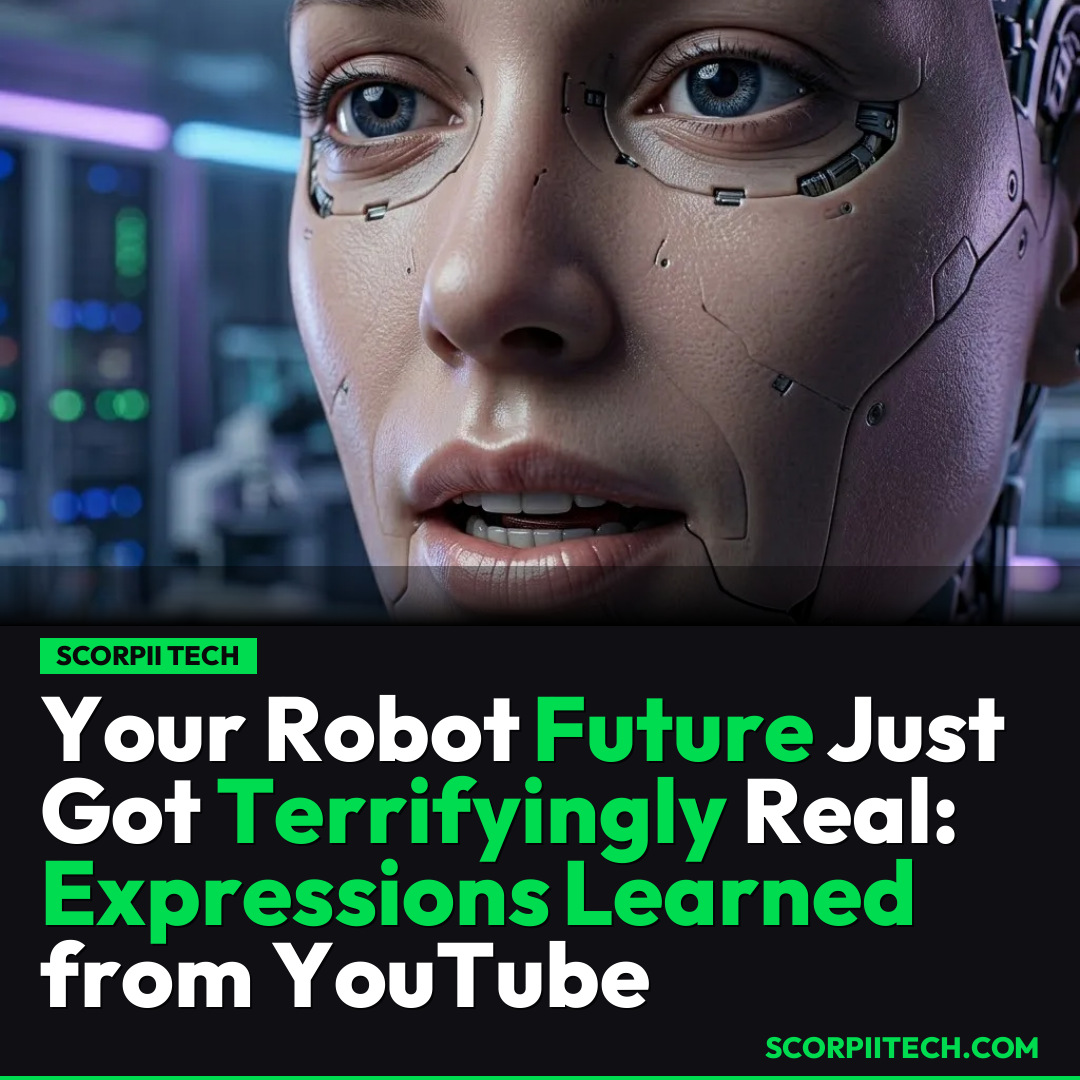
Prepare yourself, because the future of robotics just took a giant, unnerving leap. You might think you're ready for advanced AI, but a new humanoid robot developed at Columbia University is learning realistic facial expressions from YouTube videos, and the resulting video simulation is genuinely unsettling. It’s a game-changer that forces you to confront a new reality.
Key Details
Imagine a robot perfectly synchronizing its lip movements to simulate various languages and accents. That's what Professor Hod Lipson and study leader Yuhang Hu from Columbia's Creative Machines Lab have achieved. Their research, published in Science, unveils a humanoid robot with 26 intricate facial motors, controlled by a Vision-to-Action (VLA) language model. This system, trained on countless human faces from YouTube, allows the robot to mimic human-like communication with startling accuracy. You can see it performing uncanny lip syncs.
Deploy your next full-stack application effortlessly. Get $200 in free DigitalOcean credits to host your Laravel or Python APIs.
This isn't just about moving lips; it's about adding new depth to human-robot interaction. Professor Lipson states, "When the lip sync ability is combined with conversational AI such as ChatGPT or Gemini, the effect adds a whole new depth to the connection the robot forms with the human." Your future AI interactions could involve robots that not only speak but visually react and emote incredibly naturally—or perhaps, too naturally. Companies like XPENG and Neura are pushing boundaries, signaling an even more immersive era.
Why This Matters
Why should you care that a robot can pout or smile convincingly? This advancement profoundly impacts how you'll perceive and interact with artificial intelligence. For businesses, it opens new frontiers in customer service, education, and entertainment, where robots could offer more empathetic experiences. However, this also brings significant ethical challenges. The market must be careful; controversies already surround how robots should interact with people, especially as their human-like qualities become almost indistinguishable from our own.
This technology blurs the lines, forcing you to reconsider what truly constitutes 'human connection.' When a robot can genuinely simulate expressions and lip-sync with flawless precision, your brain might start to register it as more than just a machine. This raises important questions about trust, manipulation, and the psychological impact of interacting with entities that mimic human emotion without truly feeling it. It’s a complex future where your emotional responses to technology will be profoundly tested.
The Bottom Line
Your world is rapidly becoming more intertwined with advanced AI. The development of humanoid robots with sophisticated facial expressions is a clear indicator of this trajectory. While the potential for enhanced communication is immense, you must also be acutely aware of the ethical implications and the 'uncanny valley' effect. As these robots become more prevalent, it’s crucial for you to engage in conversations about their roles, boundaries, and how we ensure responsible development. Don't just marvel at the tech; actively question its place in your society to help shape a future where robots enhance, rather than diminish, human experience.
Originally reported by
BGRWhat did you think?


Stay Updated
Get the latest tech news delivered to your reader.