Why AMD's Ryzen 7700X3D Might Be Your Next CPU Upgrade
AMD's Ryzen 7 7700X3D offers near-7800X3D gaming performance for $329. Discover how much speed, thermal efficiency, and value it gives your PC build.
Editorial Note
Reviewed and analysis by M.Numan
In this article
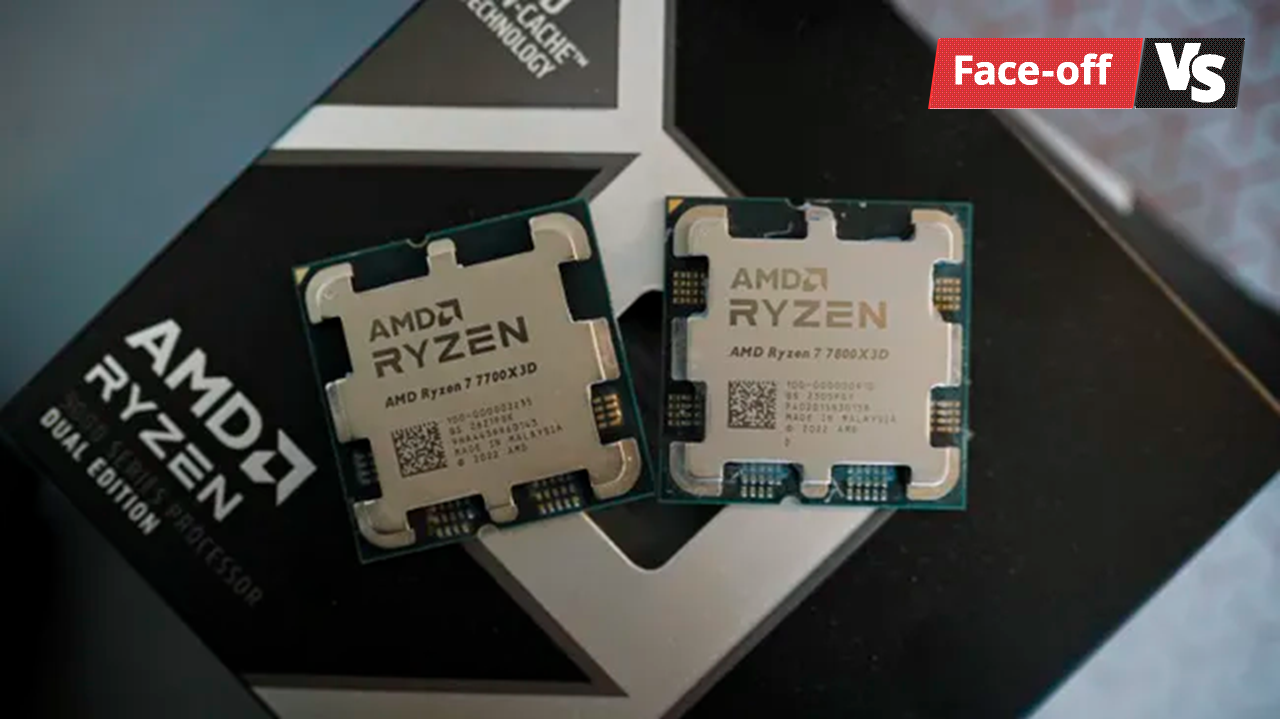
If you are building an AM5 gaming rig and want the massive frame rates of 3D V-Cache technology without overspending, AMD's newly launched Ryzen 7 7700X3D demands your attention. Released on July 16 at $329, this chip delivers near-identical hardware specifications to the market-favorite Ryzen 7 7800X3D, but cuts power draw and heat while shaving off just a fraction of clock speed.
Key Details
Under the hood, the Ryzen 7 7700X3D is fundamentally built from the same Zen 4 silicon as the 7800X3D on TSMC's N5 process. Both processors feature 8 cores and 16 threads, fit directly into the AM5 socket, and include the full 96MB of 3D V-Cache for an identical total cache pool of 104MB. They also share a 120W TDP, support up to 128GB of DDR5 memory, supply PCIe 5.0 lanes, and include AMD Radeon integrated graphics with 2 CUs. The primary difference on paper is clock speed: the 7700X3D features a 4.0 GHz base and a 4.5 GHz boost clock, sitting 500 MHz below the 7800X3D's 4.2 GHz base and 5.0 GHz boost ceiling.
Deploy your next full-stack application effortlessly. Get $200 in free DigitalOcean credits to host your Laravel or Python APIs.
When tested across a 16-game suite at 1080p using an RTX 5090, that clock deficit results in only a minor performance drop. The 7800X3D holds a modest 4.3% lead in average frame rates (181.8 FPS versus 174.3 FPS) and a 5% edge in 1% lows. In titles like Baldur's Gate 3, the 7800X3D leads by 6.4%, but in games like Flight Simulator 24 and Minecraft RT, the gap shrinks to around 2%. In DOOM: The Dark Ages, performance is practically identical, with the 7800X3D holding less than a 1% lead (201.9 FPS versus 200 FPS).
Where the 7700X3D truly shines is power efficiency and thermal management. In gaming benchmarks, the 7700X3D consumed an average of 60.9 watts compared to 67.3 watts for the 7800X3D—a 9.5% reduction in power draw. That translates directly to lower operating temperatures, with the 7700X3D running at an average of 55°C versus 62°C for its sibling. At idle, the 7700X3D draws just 19W compared to 25W for the 7800X3D, making it the consistently cooler and more frugal option.
Why This Matters
Application and productivity testing reveals a slightly wider performance gap, where the 7800X3D's higher boost clocks yield a 7% lead in multi-threaded tasks like Cinebench 2024, HandBrake x265 encoding, and Blender, along with a 10.3% advantage in single-threaded benchmarks. Neither CPU supports traditional multiplier overclocking due to the thermal layer of stacked cache, though both give you access to Precision Boost Overdrive and Curve Optimizer for minor tuning.
For your wallet, pricing between these two chips is extremely close. The 7700X3D launched as a Newegg exclusive in North America at $329 (and sits around $330), while street pricing for the older 7800X3D has dropped down to around $340 to $360. Because both chips require identical AM5 motherboards, DDR5 memory, and cooling solutions, you are choosing between raw clock speed or lower heat and power draw.
The Bottom Line
If you want the absolute highest frame rates for your AM5 gaming build, the Ryzen 7 7800X3D remains the top choice by maintaining a slight edge in every game and productivity application. However, if you prefer a system that runs 7°C cooler, sips significantly less power at idle and under load, and offers remarkable gaming efficiency without sacrificing noticeable performance, the Ryzen 7 7700X3D is a fantastic option for your rig.
Originally reported by
Tom's HardwareWhat did you think?



Stay Updated
Get the latest tech news delivered to your reader.