Your Ultrasound Infrastructure Just Got an AI Overhaul
NVIDIA and Siemens Healthineers are revamping ultrasound. Understand the NV-Raw2Insights-US pipeline's technical shift to AI-native imaging and its infrastructure impact for you.
Editorial Note
Reviewed and analysis by ScoRpii Tech Editorial Team.
In this article
The Future of Ultrasound Imaging
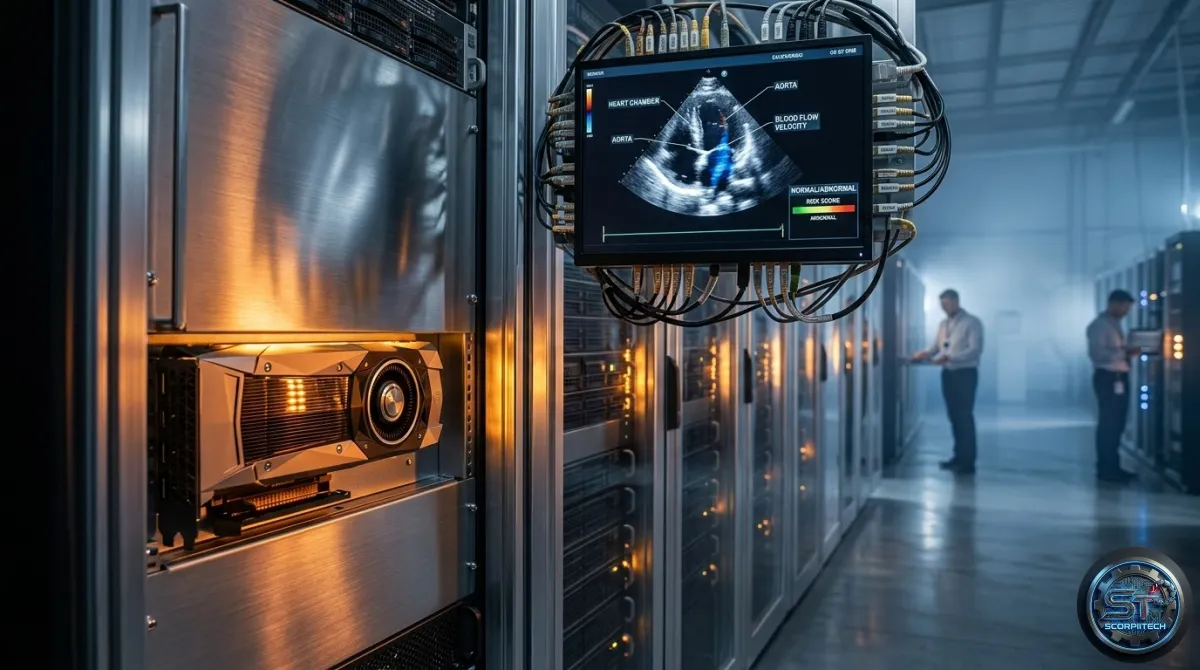
You are now witnessing a significant shift in medical imaging, particularly in ultrasound technology. The introduction of the `NV-Raw2Insights-US` framework by NVIDIA and Siemens Healthineers marks a substantial change in how ultrasound data is processed and analyzed. This new approach involves feeding raw ultrasound data directly into an AI pipeline, moving away from traditional pre-programmed algorithms.
The `NV-Raw2Insights-US` pipeline integrates with existing hardware, such as the ACUSON Sequoia ultrasound scanner, and fundamentally changes how data is handled. Instead of simply pushing display-ready images, the system is designed to extract raw sensor information, a vastly richer dataset for AI models. This raw data is routed through a `Holoscan Sensor Bridge` (HSB) which utilizes an `Altera Agilex-7 FPGA development kit`. According to Ismayil Guracar, AI & Advanced Platforms group, and Rickard Loftman, AI & Advanced Platforms group, the objective is to unlock a scalable path to AI-native imaging by making this foundational shift.
Deploy your next full-stack application effortlessly. Get $200 in free DigitalOcean credits to host your Docker containers, Laravel, or Python APIs.
Underlying Network and Compute Foundations
The operational efficiency of this `Raw2Insights` pipeline hinges on robust data transfer and high-performance compute. The `Holoscan Sensor Bridge` facilitates data movement using `Data over DisplayPort` and, critically, `RDMA over Converged Ethernet`. This choice of networking protocol is not incidental; it directly addresses the latency and throughput requirements of real-time raw data processing.
Sizing Your Single-Box VPS Architecture?
Calculate exact vCPU cores, RAM GB, NVMe storage, and estimated monthly budget for your traffic before migrating away from high-cost cluster providers.
Some key features of the `NV-Raw2Insights-US` framework include:
- Direct feeding of raw ultrasound data into an AI pipeline
- Integration with existing hardware, such as the ACUSON Sequoia ultrasound scanner
- Use of a `Holoscan Sensor Bridge` (HSB) with an `Altera Agilex-7 FPGA development kit`
- Utilization of `RDMA over Converged Ethernet` for data transfer
What This Means For Your Operations
This pivot to `AI-powered ultrasound imaging` with `NV-Raw2Insights-US` necessitates a re-evaluation of your internal compute and networking infrastructure, particularly if you operate in the medical imaging space or develop AI applications for real-time sensor data. You will need to plan for specialized hardware, including FPGAs for custom sensor integration and high-performance computing platforms like `NVIDIA IGX` and `NVIDIA DGX Spark` with `Blackwell-class GPUs`.
The Bottom Line for Developers
In conclusion, the introduction of the `NV-Raw2Insights-US` framework marks a significant shift in ultrasound imaging technology. You must consider the implications of this change on your infrastructure and operations, and plan accordingly. The use of specialized hardware and high-performance computing platforms will be crucial in unlocking the full potential of AI in diagnostics.
Originally reported by
Hugging Face BlogWhat did you think?

Stay Updated
Get the latest tech news delivered to your reader.