Why Your GPS Fails Underwater: How Submarines Navigate
You rely on GPS daily, but deep beneath the waves, it's useless. Discover the ingenious tech that allows submarines to navigate the ocean without a satellite signal.
Editorial Note
Reviewed and analysis by ScoRpii Tech Editorial Team.
In this article
You probably don't think twice about using GPS to find your morning coffee or navigate a new city. That little satellite signal is your trusty companion. But what happens when you dive thousands of feet below the ocean's surface? Your familiar GPS becomes utterly useless. Welcome to the challenging world of submarine navigation, where ingenuity, not satellites, guides the way.
Key Details
You might be surprised to learn that while your phone struggles to get a signal in a deep garage, submarines face a far more fundamental problem: GPS signals simply cannot penetrate the ocean's depths. This isn't a glitch; it's a physical limitation. Satellites like GPS, GLONASS, Galileo, and BeiDou broadcast signals that are absorbed by water, rendering them ineffective for underwater craft. So, how do these colossal vessels navigate the vast, dark sea without getting hopelessly lost?
Deploy your next full-stack application effortlessly. Get $200 in free DigitalOcean credits to host your Laravel or Python APIs.
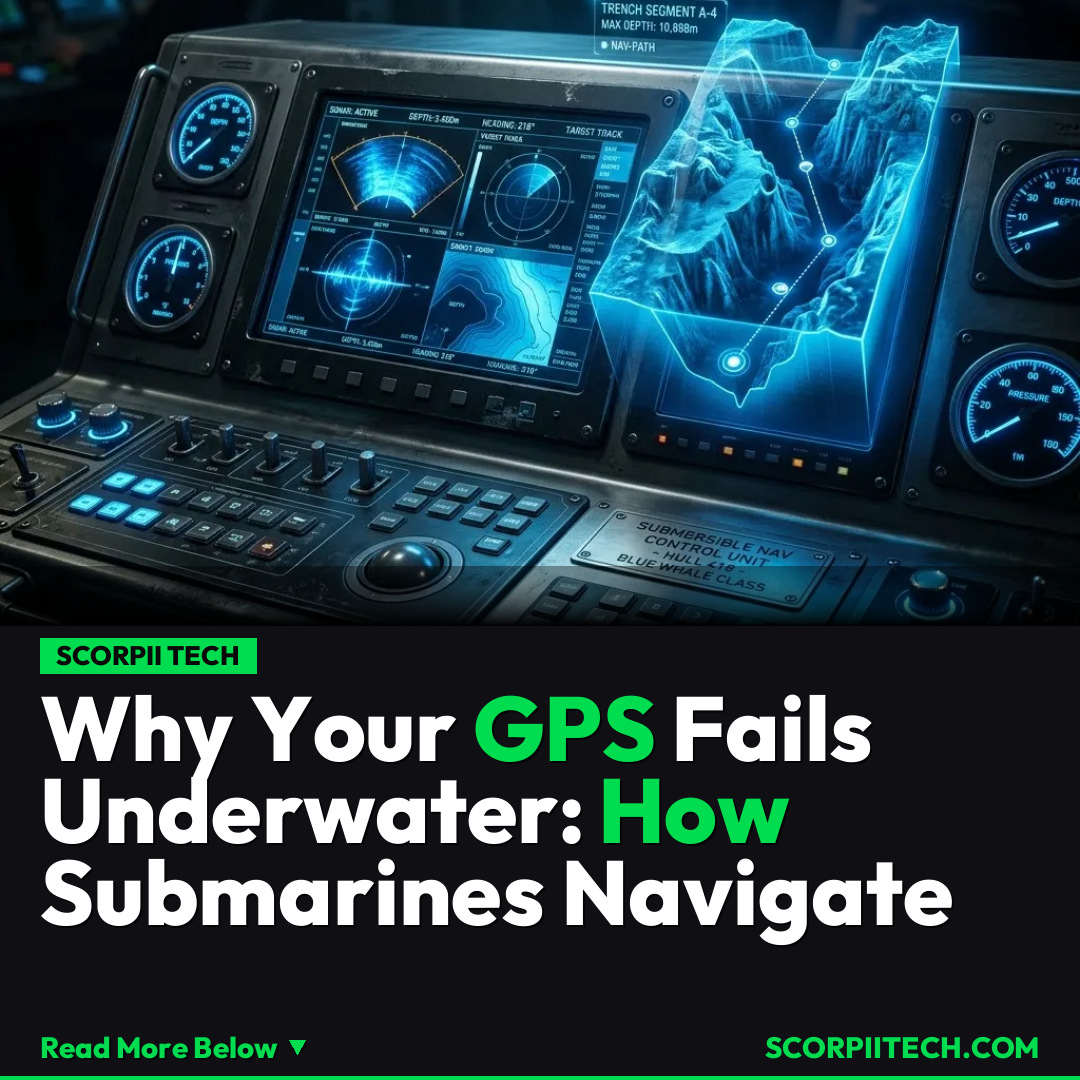
The core of submarine navigation relies on a sophisticated technology called the Inertial Navigation System (INS). Imagine a system so precise it knows exactly where it is, where it's going, and how fast, all without external reference. INS works by continuously tracking every movement of the submarine using highly sensitive gyroscopes and accelerometers. These instruments measure every subtle change in direction, speed, and displacement from a known starting point. It's like an incredibly accurate, self-contained journey logger that constantly updates the submarine's position.
Beyond INS, submarines employ a suite of other ingenious methods to cross the ocean. They still use manual dead reckoning, a time-honored technique where their position is estimated based on speed, heading, and elapsed time. Critical to this process are detailed bathymetric charts – highly accurate maps of the ocean floor's topography. Sonar plays a vital role, not just for detecting other vessels, but also for terrain-relative navigation, comparing the seafloor contours they "see" with their charts to verify their position. For limited, slow communication or coarse position updates, submarines can also utilize Extremely Low Frequency (ELF) radio waves, which can penetrate water but carry very little data.
Why This Matters
You might think this is just cool tech for niche military applications, but the principles behind submarine navigation touch on critical concepts for future autonomous systems and exploration. The ability to operate precisely and reliably in environments where traditional satellite navigation fails is a huge challenge across many fields. Think about deep-sea exploration, mapping underwater resources, or even autonomous underwater vehicles (AUVs) that need to perform complex tasks without human oversight. The reliance on robust internal systems and environmental mapping, rather than external signals, offers a blueprint for navigating any "GPS-denied" environment, from underground tunnels to distant planets.
Understanding how submarines manage to navigate also highlights the sheer complexity and engineering brilliance required for human endeavor in extreme environments. It underscores the limitations of even ubiquitous technologies like GPS and pushes us to appreciate the layered, redundant systems necessary for safety and mission success. For you, it’s a reminder that while your smartphone makes navigation seem effortless, there's a whole world of challenges (and solutions) lurking just beneath the surface, driving innovation in ways you might not expect.
The Bottom Line
So, the next time you effortlessly follow your GPS directions, take a moment to marvel at the silent, unseen world beneath the waves. Submarines aren't just navigating; they're demonstrating a masterclass in self-reliance and technological ingenuity, charting their course through the ocean's depths using gyroscopes, accelerometers, detailed maps, and sound waves. While you may never need to ditch your GPS for an INS, understanding these robust alternatives offers a fascinating glimpse into the cutting-edge of navigation and reminds you that for every technological limitation, brilliant minds are always at work, finding a way to get you where you need to be—even thousands of feet underwater.
Originally reported by
BGRWhat did you think?



Stay Updated
Get the latest tech news delivered to your reader.