Monarch API: Your Direct Line to Distributed Supercomputing
PyTorch's Monarch API addresses the complexity of distributed training on large clusters, offering you native Kubernetes support and RDMA improvements.
Editorial Note
Reviewed and analysis by ScoRpii Tech Editorial Team.
In this article
Confronting Distributed Training Complexity
You understand the challenges of scaling machine learning models across vast compute resources. Getting distributed training jobs to operate efficiently on huge clusters is difficult, especially with complex architectures like distributed reinforcement learning. Monarch, introduced by the PyTorch Blog, is designed to make your distributed systems more manageable.
Monarch provides an API that acts as a direct interface to your supercomputer, abstracting away much of the underlying distributed systems engineering. According to Shayne Fletcher, Senior Staff Engineer, 'Monarch makes the distributed system feel local and provides a toolbox to reduce the iteration time when tackling problems.' This focus on developer experience and efficiency is crucial for operationalizing large-scale AI research and deployment.
Deploy your next full-stack application effortlessly. Get $200 in free DigitalOcean credits to host your Docker containers, Laravel, or Python APIs.
Monarch's Technical Pillars for Scale
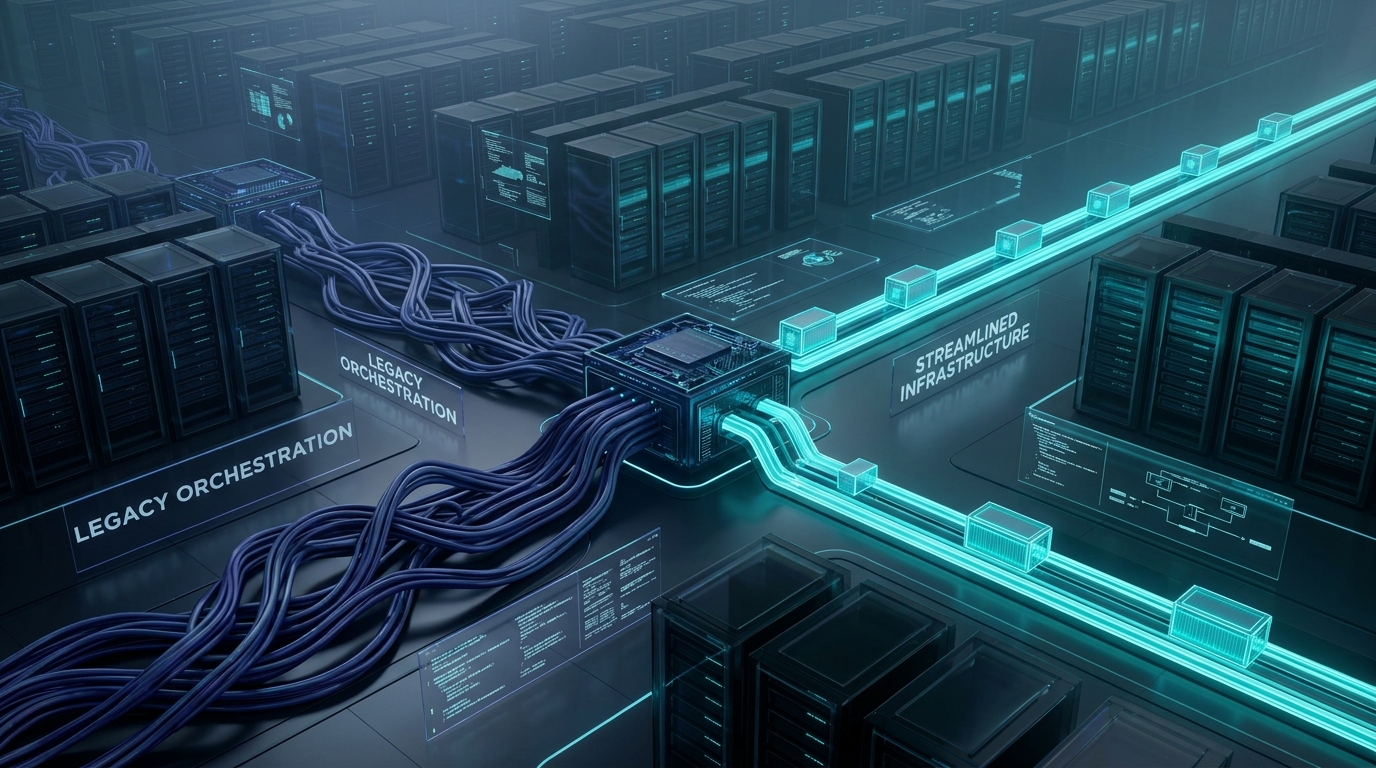
The engineering behind Monarch centers on several key technical improvements aimed at alleviating bottlenecks in distributed training. Central to its capability are significant RDMA improvements, designed to optimize data transfer across nodes. Monarch offers distributed telemetry, giving you granular insight into the behavior of your training jobs across a dispersed infrastructure. Furthermore, it includes native Kubernetes support, a critical feature for integrating into modern cloud-native deployment strategies.
Key features of Monarch include:
- RDMA improvements for optimized data transfer
- Distributed telemetry for granular insight into training jobs
- Native Kubernetes support for streamlined orchestration and resource management
Concept Refresher: Remote Direct Memory Access (RDMA)
RDMA is a technology that allows network adapters to transfer data directly to and from application memory, bypassing the CPU, caches, and operating system. When you use RDMA, a network adapter can read or write data from a remote computer's memory without involving the remote machine's CPU. This process significantly reduces latency and CPU overhead, increasing throughput for data-intensive applications.
Operationalizing Your Supercomputer with Monarch
The integration of native Kubernetes support within Monarch streamlines your orchestration and resource management. If you are already leveraging Kubernetes for your infrastructure, Monarch allows you to deploy and manage distributed training jobs with familiar tooling and workflows. This native integration reduces the operational overhead traditionally associated with configuring distributed environments, letting you focus more on model development and less on infrastructure wrangling.
What This Means For You
As a developer, Monarch presents a tangible shift in how you approach large-scale distributed training. You can expect a reduction in the engineering effort required to set up, monitor, and troubleshoot these environments. The API aims to democratize access to supercomputing capabilities for PyTorch users, enabling you to experiment with larger models and more complex distributed algorithms without the prohibitive operational cost.
💡 Hardware Sizing Tip: Planning your own VPS migration? Benchmark exact vCPU, RAM, and monthly budget requirements using our free Web Hosting & Cloud VPS Sizing Calculator.
The Bottom Line for Developers
Monarch's impact on your workflow will be significant, allowing you to iterate faster on challenging problems. With its robust communication, flexible orchestration, and deep observability, Monarch directly addresses the pain points of scaling complex machine learning workloads. By leveraging Monarch, you can optimize your distributed training jobs and achieve better results, ultimately driving business growth and innovation.
Originally reported by
PyTorch BlogM. Numan Lead Developer & CEO
Founder & Lead Architect at ScoRpii Tech · Full-Stack & AI Systems Specialist
M. Numan leads architecture and software engineering at ScoRpii Tech, specializing in high-throughput backend services, autonomous multi-agent AI workflows, and cross-platform mobile apps. He writes production blueprints and architectural benchmarks for modern engineering teams.
What did you think?
Stay Updated
Get the latest tech news delivered to your reader.