This Is What Microsoft's Stealthy Acquisitions Mean For Your Digital Life
You use their products every day, but do you know the full extent of Microsoft's digital empire? Discover how their strategic acquisitions of LinkedIn, GitHub, and gaming giants shape your tech world.
Editorial Note
Reviewed and analysis by ScoRpii Tech Editorial Team.
In this article
You might fire up your PC, open a browser, and log into your professional network, all without realizing the invisible thread connecting it all: Microsoft. Since its founding in 1975 by Bill Gates and Paul Allen to create software for the Altair 8800, this tech titan has grown far beyond Windows and Office, with strategic, multi-billion-dollar acquisitions quietly cementing its influence across nearly every facet of your digital world.
Key Details
Microsoft's journey from a small software developer in 1975, founded by Bill Gates and Paul Allen for the Altair 8800, to a global powerhouse is defined by its expansive acquisition strategy. While you've likely relied on their core products like Windows (1985) and Office (1994), the company has consistently expanded its portfolio, integrating essential services into your professional, creative, and entertainment ecosystems, often flying under the radar as you continue to use popular platforms.
Deploy your next full-stack application effortlessly. Get $200 in free DigitalOcean credits to host your Laravel or Python APIs.
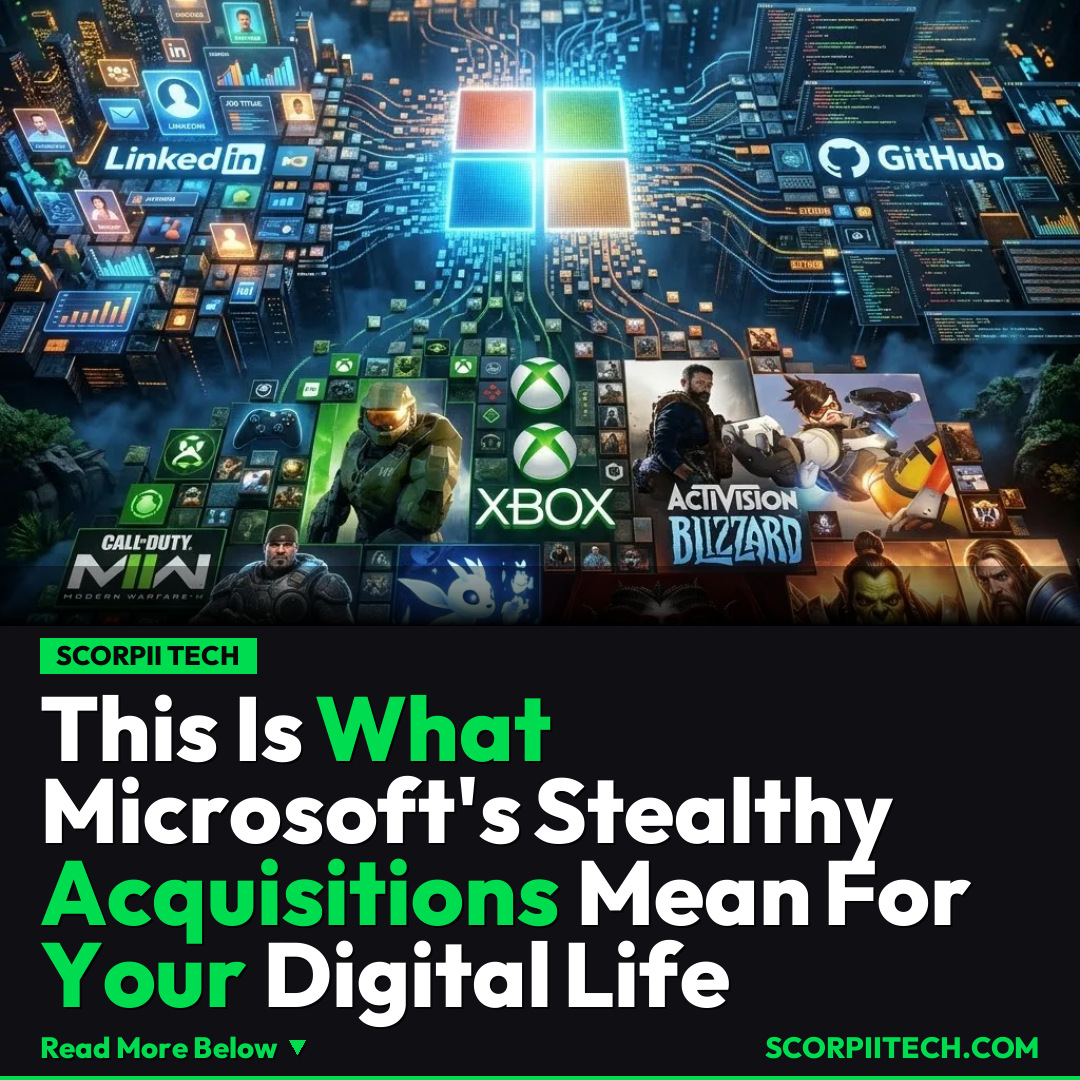
Consider your professional life. In 2016, Microsoft acquired LinkedIn for a staggering $26.2 billion. Founded in 2002, LinkedIn had 225 million users at the time and has since swelled to over 1 billion, integrating seamlessly with your Office productivity tools. If you're a developer, you know GitHub. This vital platform, founded in 2007, was acquired by Microsoft in 2018. Pre-acquisition, GitHub had 50 million users and 36 million repositories; post-acquisition, those numbers exploded to 100 million users and 180 million repositories, solidifying Microsoft's crucial role in software development.
Your entertainment world is also significantly shaped by Microsoft. In 2023, they made waves by acquiring Activision Blizzard, the gaming giant behind "World of Warcraft," for an astounding $68.7 billion. This followed their 2021 acquisition of ZeniMax Media, including Bethesda Softworks, for $7.5 billion, further expanding their Xbox ecosystem. Even your mobile typing experience might be thanks to them: SwiftKey, a predictive keyboard founded in 2008, was acquired in 2016 for $250 million, growing its user base from 100,000 to over 1 billion.
Why This Matters
So, why does this sprawling network of acquisitions matter to you? It means Microsoft isn't just the company behind your operating system; it's intricately woven into your daily digital interactions. When you network on LinkedIn, collaborate on code via GitHub, or unwind with a game on your Xbox, you're engaging with a service that funnels into Microsoft's vast ecosystem. This extensive ownership gives Microsoft unparalleled reach, influencing everything from the job market to how software is built globally.
Your data, professional connections, and entertainment choices are all part of this larger Microsoft tapestry. This interconnectedness allows for deeper integrations and a more unified user experience. However, it also means a single company holds significant sway over crucial aspects of your digital identity and access, making their policies and future directions particularly impactful for you, whether you're a student, professional, or gamer.
The Bottom Line
Understanding the true scope of Microsoft's empire isn't just trivia; it’s about recognizing the centralized control behind many of your essential digital tools. As you navigate your digital life, consider the foundational role Microsoft plays. Being aware of who owns the platforms you use empowers you to make more informed choices about your technology and appreciate the sheer scale of the companies that define our modern world.
Originally reported by
BGRWhat did you think?



Stay Updated
Get the latest tech news delivered to your reader.