Google's New AI App for iPhone: What Your Privacy Pays For
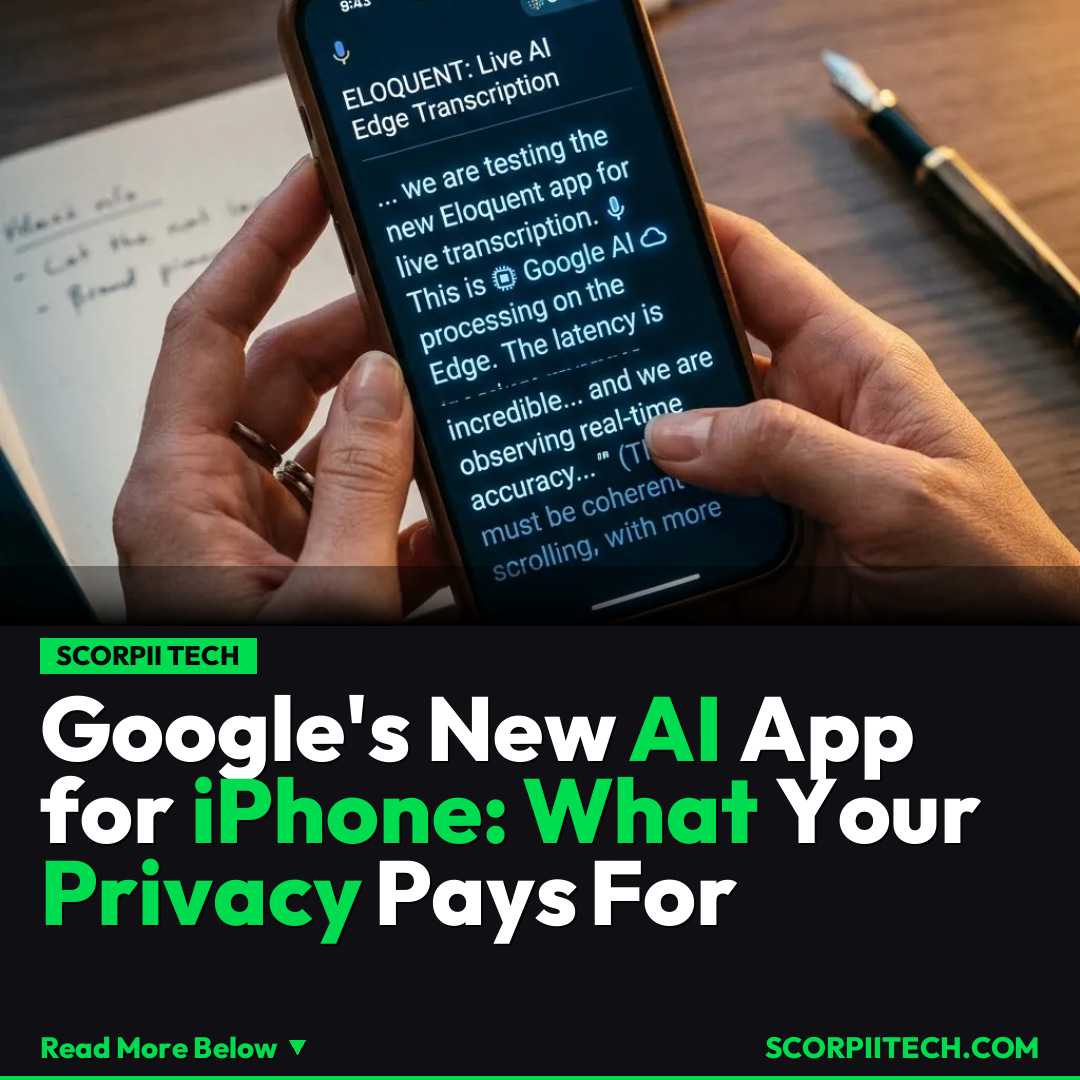
Google's new AI transcription app for iPhone, Google AI Edge Eloquent, offers stunning accuracy with 'on-device' processing, but its privacy policy collects significant user data. Will you trade privacy for powerful AI?
Editorial Note
Reviewed and analysis by ScoRpii Tech Editorial Team.
In this article
You know that moment you try a new tech tool with a healthy dose of skepticism, especially when it’s from a giant like Google? We decided to give Google's new AI transcription app for iPhone, Google AI Edge Eloquent, a shot on release day. And honestly, the accuracy was surprisingly good, even as the privacy policy gave us pause. It's a classic trade-off, isn't it?
Key Details
When Google launched its new AI transcription app for iPhone, officially named Google AI Edge Eloquent, it immediately caught our attention. Touted as a breakthrough for on-the-go transcription, its performance quickly lived up to the hype in terms of accuracy. You might typically expect some quirks or errors with new AI tools, especially when processing live audio, but this app genuinely impressed. It’s designed to bring powerful AI capabilities directly to your Apple device, leveraging advanced 'Gemma' architecture for its core processing.
Need fast, secure, and affordable hosting for your next website or PHP application? We recommend Hostinger Managed Hosting. Get premium speeds, a free domain, and 24/7 expert support.
What truly sets Google AI Edge Eloquent apart, beyond its surprising accuracy, are its two distinct operational modes. The primary 'On-device mode' handles transcription directly on your iPhone, which sounds fantastic for speed and potentially privacy – though we’ll get to that nuance shortly. Then there’s the 'Enhanced text polishing' mode, a feature that meticulously refines your transcribed text, going so far as to intelligently remove common verbal tics like 'um' and 'uh'. Imagine crisp, clean transcripts without those distracting filler words; it’s a game-changer for anyone working with interviews, lectures, or content creation, from YouTube creators to students at Audio University.
However, no new Google service comes without its considerations, and for Google AI Edge Eloquent, that consideration is privacy. While the accuracy and technical prowess are undeniably impressive, the app's privacy policy explicitly states that it collects a significant amount of user data. This detail is crucial for you to understand before fully embracing the convenience and power it offers. It poses a direct challenge to the often-held belief that 'on-device' always equals maximum privacy.
Why This Matters
For you, the implications of Google AI Edge Eloquent are twofold. On one hand, its astonishing accuracy, coupled with the ability to eliminate filler words, is a massive leap forward for productivity. If you're a student trying to capture lecture notes, a journalist recording interviews, or a content creator like those at Audio University needing quick, clean transcripts for YouTube videos, this app could dramatically streamline your workflow. The promise of 'on-device' processing also suggests faster results and less reliance on cloud services for the core transcription, which can feel more secure.
On the other hand, the extensive data collection outlined in the app’s privacy policy presents a classic dilemma in the age of digital convenience. As the old adage reminds us, "If a service is free, you are the product." While you gain exceptional transcription quality and advanced features without a direct monetary cost, you are potentially giving up valuable personal data. This isn't just about what Google *might* do with your data; it's about understanding the invisible cost of a 'free' service and consciously deciding if that trade-off is worth it for your specific needs.
The Bottom Line
So, what should you do with Google AI Edge Eloquent? The app clearly represents a significant advancement in mobile AI transcription, offering accuracy and features that could genuinely boost your productivity. Before you hit download or start using it extensively, take a moment to weigh its impressive capabilities against the privacy implications. Read through that privacy policy yourself, understand what data is being collected, and then make an informed decision based on your comfort level. Ultimately, the power is yours to choose whether the convenience of this surprisingly accurate AI is worth the data it gathers.
Originally reported by
LifehackerWhat did you think?



Stay Updated
Get the latest tech news delivered to your reader.